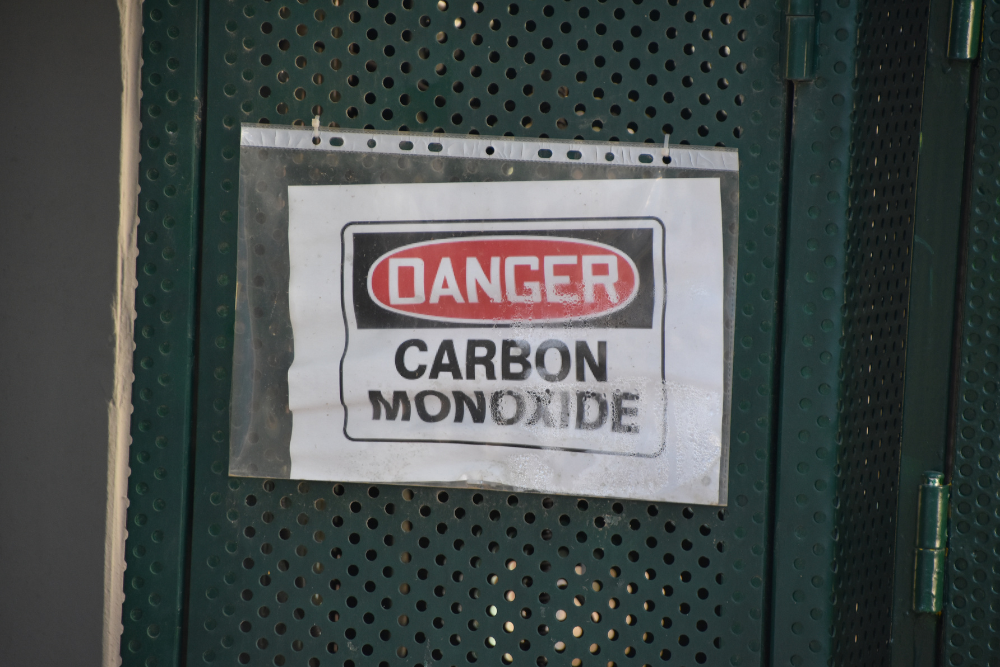
When temperatures drop, crews close the bay doors, tarp in the building, and fire up the heaters. Those are reasonable steps to keep people warm and work moving. They also create the perfect conditions for carbon monoxide (CO) to build up.
CO is colorless, odorless, and tasteless. Workers often don't realize they are being exposed until they feel sick, and by then their judgment may already be impaired. Every winter, CO incidents send workers to the hospital from construction sites, maintenance shops, warehouses, and loading docks.
This guide covers where CO comes from on winter worksites, how exposure affects the body, the legal exposure limits, and the controls that keep crews safe.
What Is Carbon Monoxide and Why Is It So Dangerous?
Carbon monoxide is a gas produced when fuel burns incompletely. Any engine or appliance that burns gasoline, diesel, propane, natural gas, kerosene, wood, or coal can produce it.
How CO Affects the Body
When you breathe in CO, it binds to the hemoglobin in your red blood cells far more readily than oxygen does. That forms carboxyhemoglobin and blocks your blood from carrying oxygen to your brain, heart, and other organs. The result is oxygen starvation, even though the air may look and feel normal.
CO can harm workers in two ways:
- High concentrations over a short time, such as a generator running in a closed room, can cause collapse and death within minutes.
- Lower concentrations over a long shift, such as a poorly vented heater in a shop, can cause headaches, fatigue, and impaired judgment that lead to other injuries.
Symptoms to Watch For
Early symptoms are easy to mistake for the flu or a long day:
- Headache
- Dizziness or lightheadedness
- Nausea or vomiting
- Fatigue and weakness
- Shortness of breath
- Confusion or poor coordination
At higher exposures, workers may lose consciousness, suffer seizures, or die. A key warning sign is when several people in the same area feel sick at the same time, or when symptoms improve after leaving the work area.
Who Is at Higher Risk
Workers with heart or lung disease, pregnant workers, and smokers (who already carry higher carboxyhemoglobin levels) are more vulnerable. Heavy physical work also increases breathing rate, which increases the dose of CO a worker takes in.
Exposure Limits for Carbon Monoxide
OSHA's 50 ppm limit is the legal requirement for general industry and construction. Many safety programs use the more protective NIOSH limits to set alarm points and action levels.
Common Sources of CO on Winter Worksites and Shops
Temporary Heaters
Propane, kerosene, and diesel heaters, including the "salamander" or torpedo heaters common on construction sites, are the top winter source. Direct-fired heaters release their exhaust straight into the space they heat. In a tarped enclosure or a building with doors closed, CO can climb quickly.
Gas-Powered Tools and Equipment
Small engines produce a surprising amount of CO. Common culprits include:
- Concrete saws, power trowels, and floor grinders
- Pressure washers and floor buffers
- Portable generators and welders
- Pumps and compressors
Never run a generator indoors, in a garage, or near doors, windows, or air intakes, even with ventilation.
Forklifts and Vehicles
Propane forklifts in warehouses and gasoline or diesel vehicles idling in maintenance bays are major sources. A poorly tuned propane forklift can produce far more CO than a properly maintained one. Trucks warming up inside a shop on a cold morning can raise CO levels throughout the building.
Furnaces and Building Systems
Cracked heat exchangers, blocked flues, and poorly maintained boilers can leak CO into occupied spaces. Winter is when these systems run hardest and when problems show up.
How to Control Carbon Monoxide Exposure
The most effective controls remove or reduce the source. PPE alone is not a practical solution for CO.
Substitute Cleaner Equipment
Where possible, swap fuel-burning equipment for electric or battery-powered alternatives. Electric heaters, battery-powered saws and trowels, and electric forklifts eliminate CO at the source.
Use Indirect-Fired Heaters
Indirect-fired heaters burn fuel in a separate chamber and vent the exhaust outside. They cost more than direct-fired units, but they keep combustion gases out of the work area.
Ventilate and Capture Exhaust
- Install tailpipe exhaust extraction hoses in vehicle bays.
- Use fans and ductwork to bring in fresh air and push exhaust outside.
- Keep fuel-burning equipment outside and away from air intakes when possible.
- Do not idle vehicles indoors. Pull them in only when ready to work.
Monitor the Air
Install fixed CO monitors in shops, warehouses, and other enclosed areas where fuel-burning equipment runs. Give crews in temporary enclosures personal or area monitors with audible alarms. Many employers set a low alarm near the NIOSH limit of 35 ppm and a high alarm that triggers evacuation near the 200 ppm ceiling. Calibrate and bump-test monitors according to the manufacturer's schedule.
Maintain Equipment
Inspect and service heaters, engines, and forklifts before winter starts and throughout the season. Have forklift emissions checked and tuned. Have furnaces, flues, and boilers inspected annually. (See our guide to preventive maintenance strategies.)
Train Workers
Teach workers where CO comes from, how to recognize symptoms, what the monitor alarms mean, and what to do if someone shows signs of exposure. Cover it in winter toolbox talks, especially before crews start using temporary heat.
What to Do in a CO Emergency
- Move everyone to fresh air immediately.
- Call 911 for anyone with symptoms, especially confusion, fainting, or chest pain.
- Shut off the source only if it can be done safely without re-entering a high-CO area.
- Do not re-enter until the area has been ventilated and air monitoring confirms safe levels.
- Report and investigate the incident to find and fix the root cause.
Note that a standard fingertip pulse oximeter cannot reliably detect CO poisoning. It may show a normal reading even when a worker is seriously poisoned. Medical evaluation is essential.
How SMS360 Helps
SMS360 helps you build CO controls into everyday work. Use Audits & Inspections for daily heater and monitor checklists, Training Management to assign and track winter hazard training, Safety Data Sheets to keep fuel SDSs accessible, and Incident Management to log exposures and corrective actions. Request a demo to see it in action.
Frequently Asked Questions
Is it safe to use a propane heater inside a building under construction?
It can be, but only with the right controls. Direct-fired propane heaters release all of their combustion products, including CO, into the space they heat. In a well-ventilated area with good air movement, that may stay within safe limits. In a tarped enclosure, a closed-up building, or a basement, CO can build up quickly. Before using any fuel-fired heater indoors, follow the manufacturer's instructions for ventilation and clearances, provide fresh air, and use CO monitors with audible alarms. Indirect-fired heaters, which vent exhaust outside, or electric heaters are safer options for enclosed spaces. Also remember that propane heaters consume oxygen and add moisture to the air, so ventilation matters for more than CO alone.
How do I know if CO levels in my shop are too high?
The only reliable way is to measure. CO has no color, smell, or taste, so you cannot sense it. Install fixed CO monitors in areas where vehicles, forklifts, heaters, or gas-powered tools operate, and give workers in temporary or confined areas portable monitors. Compare readings to OSHA's legal limit of 50 ppm averaged over eight hours and NIOSH's more protective limit of 35 ppm. If your readings regularly come close to those levels, investigate the sources and improve controls. For a full picture, an industrial hygienist can perform personal air sampling over a full shift to measure each worker's actual exposure. Also pay attention to workers. Repeated headaches or nausea that improve after leaving the area are a red flag.
Can CO poisoning happen outdoors?
Yes, though it is less common. CO can build up outdoors in partially enclosed areas such as trenches, excavations, loading docks with overhangs, or spaces between parked trucks. Exhaust can also be drawn into buildings or vehicle cabs through open doors, windows, and air intakes. Workers operating gas-powered tools in a trench, or running a generator next to an open doorway, can be exposed even though they are "outside." Calm, cold air can also trap exhaust close to the ground. Treat any area with limited air movement as a potential CO hazard, keep equipment exhaust pointed away from people and openings, and use monitoring when crews work near running engines in tight spaces.
Is a CO exposure at work recordable on the OSHA 300 log?
It depends on the outcome. A work-related CO exposure is recordable if it meets OSHA's general recording criteria. That includes cases where the worker receives medical treatment beyond first aid (oxygen therapy given as treatment, for example), loses consciousness, misses work, is placed on restricted duty, or dies. A worker who simply goes outside and recovers with no treatment is generally not recordable, but you should still document it as an incident or near miss and investigate it. Serious cases, such as an in-patient hospitalization, must also be reported to OSHA within 24 hours, and a fatality within 8 hours. Whether or not a case is recordable, treat every CO exposure as a warning that your controls failed.
What is the best way to protect forklift operators from CO in a warehouse?
Start with the equipment. Electric forklifts produce no CO at all, so switching from propane is the most effective option when it is practical. If you keep propane forklifts, have their engines tuned and emissions tested regularly. A poorly tuned engine can produce many times more CO than a properly maintained one. Make sure the warehouse has enough general ventilation, especially in winter when dock doors stay closed. Install fixed CO monitors in the areas where forklifts operate most, and set alarms below the OSHA limit. Train operators to recognize symptoms and to report headaches or dizziness right away. Finally, avoid idling, and limit the number of forklifts operating in small or poorly ventilated areas at the same time.