Eye injuries are among the most common and preventable workplace incidents. According to the U.S. Bureau of Labor Statistics, nearly 20,000 eye injuries occur on the job every year in the United States alone — and the vast majority of them could have been avoided with the right protective eyewear. Whether you manage a construction site, a manufacturing floor, a laboratory, or a warehouse, understanding workplace safety glasses is one of the most straightforward investments you can make in worker health and regulatory compliance.
This guide covers everything you need to know about safety glasses for work: what they are, how they differ from regular eyewear, the types available, the standards they must meet, and how to build a protective eyewear program that actually holds up in the field.
What Are Workplace Safety Glasses?
Workplace safety glasses are a category of personal protective equipment (PPE) specifically engineered to shield the eyes from occupational hazards. Unlike standard prescription or fashion eyewear, safety glasses are designed and manufactured to withstand impacts, resist chemical splashes, block ultraviolet radiation, and protect against airborne particles — depending on the lens and frame specifications.
The core difference between safety glasses and regular glasses comes down to materials, construction standards, and testing requirements. Safety glasses must meet rigorous impact resistance standards before they can be marketed or used as PPE. Frames are typically made from polycarbonate, nylon, or other high-impact materials. Lenses are substantially thicker and more impact-resistant than optical lenses and are often made from polycarbonate or Trivex.
Why Regular Eyeglasses Are Not Enough
A common misconception among workers and employers alike is that prescription glasses or sunglasses offer adequate eye protection at work. They do not. Regular eyewear is not tested for impact resistance, does not meet ANSI or OSHA standards, and may actually increase the risk of injury in certain environments. When regular lenses shatter on impact, they can create secondary projectiles that cause more serious lacerations than the original hazard would have.
OSHA's eye and face protection standard (29 CFR 1910.133 for general industry and 29 CFR 1926.102 for construction) requires that protective eyewear meet the standards set by the American National Standards Institute. Employers cannot substitute regular glasses, no matter how thick the lenses appear, to satisfy this requirement.
When Are Safety Glasses Required?
OSHA requires employers to conduct a hazard assessment of the workplace and provide appropriate eye protection whenever a risk of eye injury exists. Common situations that require protective eyewear include:
• Working with or near flying particles, chips, or debris
• Handling hazardous chemicals or liquids
• Exposure to harmful light radiation such as welding arcs, lasers, or intense UV sources
• Working near molten metal or extreme heat
• Operations involving dust, sand, or other fine airborne particles
• Work in environments with biological hazards
The specific type of protective eyewear required depends on the hazard present. Safety glasses are appropriate for many general industrial tasks, but goggles, face shields, or welding helmets may be necessary for higher-risk exposures.
ANSI/ISEA Z87.1: The Standard That Defines Safety Eyewear
The primary standard governing safety glasses for work in the United States is ANSI/ISEA Z87.1, published by the American National Standards Institute in collaboration with the International Safety Equipment Association. This standard defines the design, performance requirements, testing methods, and marking requirements for all occupational eye and face protection devices. Any safety eyewear sold or used in the United States as PPE must comply with the most current version of this standard.
What Z87.1 Tests and Covers
The standard covers a broad range of performance criteria to ensure that safety glasses hold up under the conditions workers actually face. Key testing categories include:
• High-impact resistance: Lenses must withstand a steel ball dropped from height without fracturing or penetrating
• High-velocity impact: Lenses must withstand a steel ball fired at high speed — this is the more demanding test required for industrial environments
• Optical quality: Lenses must meet refractive power, prism, and haze standards to ensure they do not distort vision in a way that creates other hazards
• Coverage requirements: Frames must provide adequate coverage of the orbital area
• Lens treatments: Anti-fog, anti-scratch, and UV coatings are tested separately and must meet defined performance thresholds to be claimed on the product
How to Read Z87.1 Markings
Every lens and frame on compliant safety eyewear must be permanently marked. Understanding these markings helps employers and workers confirm they are using eyewear that meets the required standard for their specific hazard. The base mark Z87 indicates compliance with the standard. Additional characters indicate specific performance ratings:
• Z87+: Passes the high-velocity impact test — required for most industrial environments
• D3: Splash and droplet protection
• D4: Dust protection
• D5: Fine dust protection
• W followed by a shade number: Welding filter lens
• U followed by a number: UV protection scale
• L followed by a number: Visible light filter scale
• R followed by a number: Infrared filter scale
When purchasing safety eyewear for your workforce, always verify that lenses carry the Z87 or Z87+ marking and that the frame carries the manufacturer's mark and the Z87 designation. Eyewear without these permanent markings does not meet the standard regardless of how it is marketed.
Types of Workplace Safety Glasses and Protective Eyewear
Not all eye hazards are the same, and not all safety eyewear is designed to handle every risk. Choosing the right type of protective eyewear starts with understanding the hazard profile of the work environment and matching it to the appropriate protection category.
Safety Glasses
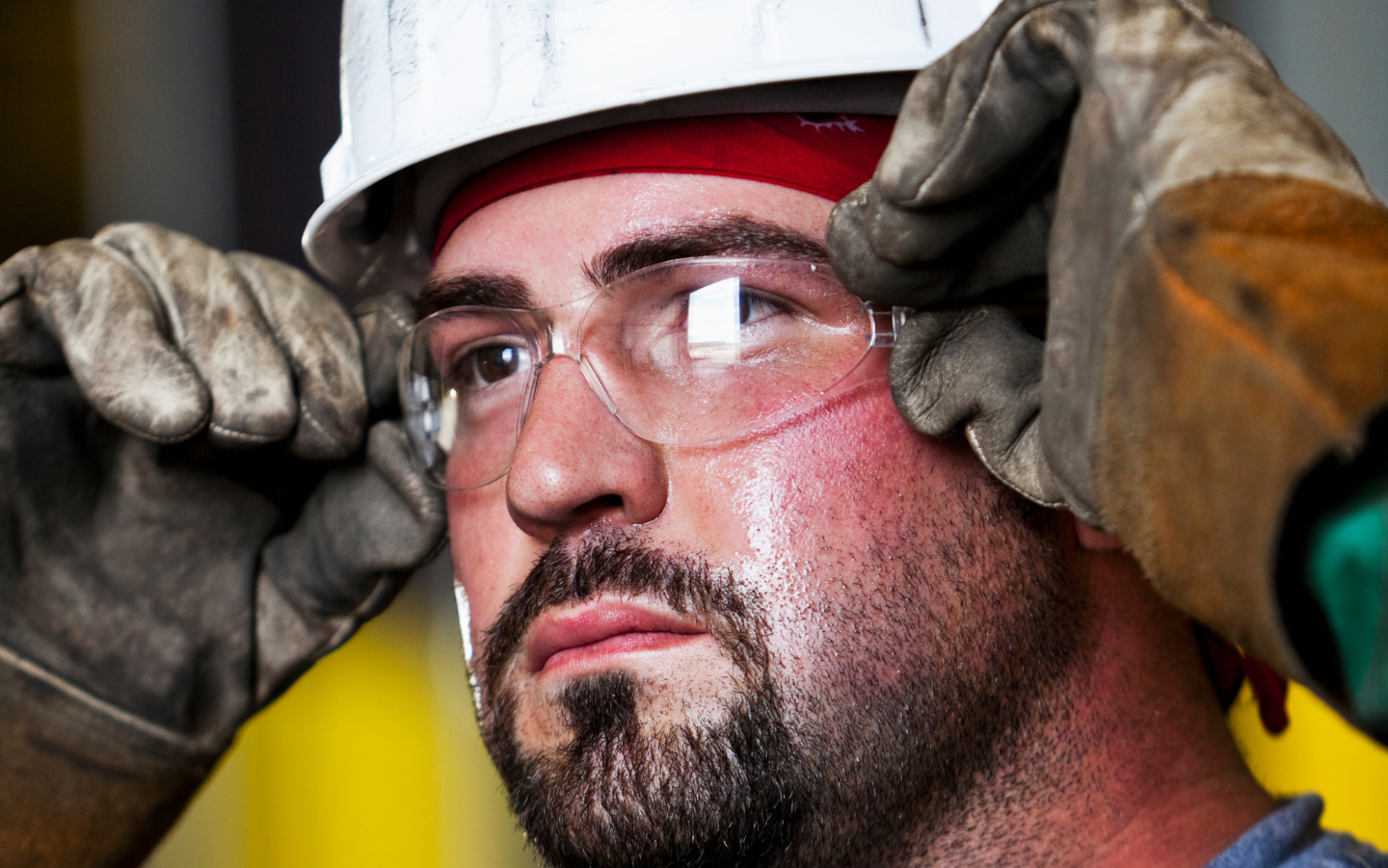
Standard safety glasses are the most commonly used form of protective eyewear in general industry. They look similar to regular glasses but are built to Z87.1 standards. They are appropriate for environments where the primary hazard is flying particles, chips, or light dust. Safety glasses provide front and limited side protection. Many designs include side shields — either fixed or removable — to improve lateral coverage.
Safety glasses are available in a wide range of styles, including wraparound frames that provide more complete coverage than traditional straight-arm designs. Lens tints are also available for outdoor work, where glare or UV exposure is a factor.
Safety Goggles
Safety goggles provide a sealed or indirect-vented enclosure around the eye, offering superior protection compared to standard safety glasses for environments with chemical splash risks, fine dust, or mist. Goggles sit flush against the face and prevent hazardous materials from entering around the frame — a critical difference from glasses, which leave gaps between the lens and face.
Goggles are required over safety glasses in situations involving liquid chemical handling, grinding operations with heavy dust, and environments where airborne particles can enter from multiple angles. They are also available in anti-fog-coated versions, which is important for workers moving between different temperature environments.
Prescription Safety Glasses
Workers who require vision correction cannot simply wear their prescription eyeglasses under safety glasses without careful consideration. OSHA allows for several approaches: prescription safety glasses (lenses ground to the worker's prescription and meeting Z87.1 standards), plano safety glasses worn over prescription eyeglasses (over-the-glass or OTG designs), or goggles designed to accommodate prescription inserts.
Prescription safety glasses are generally the most comfortable and practical solution for workers who require correction and perform tasks that demand precise vision. Employers in industries where workers wear PPE for extended periods often find that providing prescription safety eyewear reduces compliance issues and the risk of workers removing their protection due to discomfort.
Welding Glasses and Shade Lenses
Welding and cutting operations produce intense visible light, UV, and infrared radiation that can cause arc eye — a painful and potentially vision-threatening condition — as well as long-term damage from chronic exposure. Safety glasses for welding applications must include a filter lens with the appropriate shade number for the type of welding being performed. ANSI Z87.1 and OSHA provide shade number recommendations based on the welding process.
Face Shields
Face shields protect the entire face rather than the eyes alone and are required for tasks with significant splash, impact, or heat hazards. Importantly, face shields are not a standalone substitute for safety glasses or goggles. OSHA requires that workers wear safety glasses or goggles beneath a face shield, as face shields alone do not provide adequate eye protection if they are raised or if a hazard gets behind the shield.
Lens Materials, Coatings, and Features
The lens is the most critical component of any safety glass. Different materials and coatings serve different purposes, and selecting the right lens for the work environment can make a significant difference in both protection level and worker compliance.
Polycarbonate Lenses
Polycarbonate is the most widely used material in safety eyewear lenses. It offers excellent impact resistance, is lightweight, and provides inherent UV protection up to 99.9 percent. Most safety glasses marketed for industrial use feature polycarbonate lenses. The main trade-off is scratch resistance — polycarbonate is softer than glass and requires an anti-scratch coating for extended durability in abrasive environments.
Trivex Lenses
Trivex is a newer lens material that matches polycarbonate in impact resistance but offers slightly better optical clarity and greater resistance to scratching. It is lighter than polycarbonate and is available in prescription versions. Trivex lenses are a strong choice for workers who wear safety glasses for long periods and find optical distortion fatiguing.
Glass Lenses
Glass lenses offer superior scratch resistance and optical clarity but are heavier and less impact-resistant than polycarbonate or Trivex. They are used primarily in applications where chemical resistance or scratch resistance is the primary concern and impact hazard is low. Glass lenses are not appropriate for high-velocity impact environments.
Anti-Fog Coatings
Anti-fog coatings are one of the most practically important features in workplace safety glasses, particularly for workers moving between temperature zones, working in humid environments, or wearing face masks that direct exhaled breath upward. Fogged lenses are not just inconvenient — they create a genuine safety hazard when workers remove their eyewear to see clearly. Look for safety glasses with a permanent anti-fog treatment rather than a surface coating that degrades with cleaning.
Lens Tints and Filters
Clear lenses are appropriate for indoor or low-light environments. Gray and smoke tints reduce overall brightness without distorting color and are appropriate for outdoor work. Indoor/outdoor lenses use a lighter tint suitable for variable lighting conditions. Amber and yellow lenses enhance contrast and depth perception in low-light or overcast conditions. Mirrored lenses reflect intense sunlight and are appropriate for high-glare outdoor environments.
Building an Effective Protective Eyewear Program
Providing the right safety glasses is only one component of an effective eye protection program. OSHA compliance and meaningful worker protection require a systematic approach that includes hazard assessment, equipment selection, training, maintenance, and enforcement.
Conducting a Hazard Assessment
OSHA requires employers to assess workplace hazards before selecting PPE. For eye protection, this means identifying all tasks where eye hazards are present or possible, the type of hazard involved, the severity of potential exposure, and whether engineering or administrative controls could eliminate or reduce the hazard before PPE is required.
Document the hazard assessment in writing. This documentation serves as evidence of due diligence in the event of an inspection or incident investigation and provides the baseline for selecting the right eyewear for each job role and task.
Selecting the Right Eyewear for Each Task
Once hazards are identified, match the protection level to the risk. A worker performing light assembly in a clean room has different needs than a maintenance technician grinding metal or a chemical handler working with corrosive liquids. Avoid the temptation to select a single type of safety eyewear for the entire facility if the work involves materially different hazards.
Training Workers on Proper Use and Fit
Safety glasses only protect workers who wear them correctly. Training should cover how to inspect eyewear for damage before each use, how to fit and adjust the frame for a secure seal, the limitations of the eyewear selected, proper cleaning and storage procedures, and when to replace damaged or worn eyewear. Workers who understand why the specific eyewear was selected for their task — rather than just being told to wear it — are more likely to comply consistently.
Maintenance and Replacement
Scratched, cracked, or damaged lenses reduce optical clarity and compromise impact resistance. Establish a clear replacement policy that sets criteria for when eyewear must be discarded and replaced. Provide cleaning stations with appropriate cloths and solutions in work areas to encourage proper maintenance. Do not allow workers to clean polycarbonate lenses with dry rags or paper towels, as this accelerates scratching.
Frequently Asked Questions About Workplace Safety Glasses
What Is the Difference Between Safety Glasses and Safety Goggles, and How Do I Know Which One My Workers Need?
Safety glasses and safety goggles both protect the eyes, but they are designed for different hazard profiles and provide meaningfully different levels of protection. Understanding the distinction is critical for employers selecting PPE and for workers who need to know that their eyewear is appropriate for the specific task at hand.
Safety glasses are an open design — they sit in front of the eyes and provide protection from the front and limited sides, but there are gaps between the lens, frame, and face. This makes them suitable for environments where the primary hazard is impact from flying debris, chips, or particles that are approaching from a limited arc in front of the worker. Standard safety glasses with side shields extend that coverage somewhat, and wraparound designs reduce the gap further, but they do not create a sealed barrier around the eye.
Safety goggles, by contrast, are designed to sit flush against the face and create an enclosed or semi-enclosed protective envelope around the orbital area. This seal is what makes goggles necessary — and safety glasses insufficient — for chemical splash hazards, fine dust, mist, and vapors. When a worker is handling corrosive chemicals, a splash that enters the gap between a safety glasses frame and the face can cause a serious chemical burn. Goggles prevent this by eliminating that gap.
There are two main types of goggles: direct-vent goggles, which have small perforations in the frame to allow airflow and prevent fogging, and indirect-vent goggles, which route ventilation through baffled channels so that liquid cannot enter even when vents are open. Indirect-vent goggles are required for chemical splash environments. Direct-vent goggles are suitable for dust and impact environments where splash is not a concern.
The practical rule for employers is this: if the hazard is primarily impact or particle-based and the exposure is from a defined direction, safety glasses are usually appropriate. If the hazard involves liquids, chemical vapors, fine airborne dust, or exposures from multiple directions including overhead, goggles are the correct choice. When in doubt, goggles provide a higher baseline of protection, though workers may find them less comfortable for extended wear — an important compliance consideration.
Do Prescription Glasses Count as Safety Glasses at Work?
No. Prescription eyeglasses — regardless of the lens thickness, frame material, or how durable they appear — do not meet OSHA's requirements for protective eyewear at work. This is one of the most common misunderstandings in workplace eye safety and one that has contributed to preventable eye injuries. The fact that a worker wears glasses does not mean their eyes are protected.
The reason is straightforward: prescription eyeglasses are manufactured to optical standards, not safety standards. They are not tested for impact resistance, they do not carry the ANSI Z87.1 marking, and the lenses — even polycarbonate prescription lenses — are typically thinner than safety lenses and are not manufactured to the same impact resistance specifications. When struck by a high-velocity projectile or flying debris, regular prescription lenses can shatter and create secondary fragmentation hazards.
OSHA provides employers with three compliant options for workers who require vision correction. First, prescription safety eyewear: lenses ground to the worker's prescription in frames that meet the Z87.1 standard. These must be marked Z87 and are available from optical providers that specialize in industrial safety eyewear. Second, over-the-glass (OTG) safety glasses: plano safety glasses designed with a frame profile deep enough to fit comfortably over standard prescription eyeglasses. These are a practical solution when prescription safety glasses are not feasible, but workers often find them heavy or uncomfortable for extended wear. Third, safety goggles with prescription inserts: goggles with an internal optical frame that holds a prescription lens insert while the outer goggle provides the primary protective barrier.
For workers who require eye protection and wear corrective lenses every day, providing prescription safety eyewear is generally the best investment. Workers are more likely to comply with eyewear requirements when the PPE is comfortable and does not interfere with their vision. Some employers offer a safety eyewear allowance or reimbursement program to facilitate this, and many prescription safety eyewear providers offer bulk pricing for industrial accounts.
Employers should document which workers require corrective lenses and ensure that the PPE selection process accounts for this. Simply issuing standard safety glasses to a worker who wears prescription eyeglasses and cannot see clearly without them is not a compliant or effective solution.
What Do the Markings on Safety Glasses Lenses Actually Mean?
Every compliant pair of safety glasses carries permanent markings on both the lens and the frame, and understanding those markings is important for purchasing managers, safety professionals, and workers who want to confirm that their eyewear actually meets the standard for their work environment. These markings are required by ANSI/ISEA Z87.1 and cannot legally be applied to eyewear that has not passed the corresponding tests.
The foundational marking is Z87, which indicates that the eyewear meets the basic requirements of the ANSI/ISEA Z87.1 standard, including basic impact resistance. The enhanced marking Z87+ indicates that the eyewear has passed the more rigorous high-velocity impact test — a steel ball fired at high speed must not penetrate or fracture the lens. Z87+ is the correct standard for most industrial environments. If your facility involves flying debris, grinding, machining, woodworking, or any other task where high-velocity particles are a realistic hazard, Z87+ is the minimum acceptable standard.
Additional letter and number codes indicate specific performance certifications. D3 indicates the eyewear provides protection against liquid splash and droplets. D4 means the eyewear provides dust protection. D5 indicates fine dust protection, which requires a tighter seal than D4. W followed by a shade number indicates a welding filter with that shade rating — for example, W3 is appropriate for light oxy-fuel work while W14 is required for high-amperage arc welding. U followed by a number indicates a UV protection scale rating. L followed by a number indicates a visible light filter, and R followed by a number indicates infrared filtration.
Frame markings complement lens markings. The frame must carry the manufacturer's mark and the Z87 designation. Frames that do not carry this marking are not compliant safety frames, even if they look similar to certified products. This matters because the frame is a critical component of the protective system — a Z87+ lens in a non-compliant frame does not constitute compliant PPE.
When purchasing safety eyewear, require suppliers to confirm the specific Z87.1 markings present on the products you are buying. Do not rely on marketing language like 'safety-rated' or 'impact-resistant' without confirming the Z87 mark. These terms have no defined regulatory meaning without the corresponding ANSI certification, and eyewear marketed with vague safety language but lacking Z87 markings does not satisfy OSHA requirements.
How Should Safety Glasses Be Cleaned, Maintained, and Replaced?
Safety glasses are a critical piece of personal protective equipment, and their effectiveness depends on being maintained in good condition. Scratched, cracked, dirty, or degraded lenses reduce optical clarity, create visual fatigue, and compromise the impact resistance that makes safety eyewear effective. A systematic approach to maintenance and replacement is an important — and often overlooked — component of any eye protection program.
Cleaning is the most frequent maintenance task and also the one most likely to cause unintentional damage if done incorrectly. Polycarbonate and Trivex lenses, which are used in the vast majority of safety glasses, are softer than glass and will scratch if wiped with dry materials. Workers should never clean safety lenses with dry rags, paper towels, shop cloths, or shirt fabric. The correct approach is to rinse the lens with clean water first to remove loose abrasive particles, then clean with a lens-safe solution and a soft microfiber cloth. Many workplaces post cleaning station instructions alongside the dispensing stations to reinforce correct technique.
Anti-scratch coatings on polycarbonate lenses extend the lens life but do wear down over time and with repeated cleaning. Lenses that have developed significant scratching across the visual field should be replaced. The standard for replacement is straightforward: if the scratches interfere with clear vision or create glare that distracts the worker, the eyewear should be replaced. Some facilities set a time-based replacement schedule as a practical alternative to case-by-case assessment.
Anti-fog coatings also degrade with use and improper cleaning. If anti-fog performance was a factor in the original eyewear selection, workers should be trained to avoid cleaning methods that accelerate coating degradation — including wiping lenses while dry, using solvent-based cleaners, or using excessively hot water. When anti-fog performance fails, the eyewear should be replaced rather than continuing to use fogged eyewear, which creates its own safety hazard.
Frame inspection should be part of the pre-use check. Workers should inspect frames before each shift for cracks in the frame material, bent or loose temples that prevent a secure fit, damaged or missing side shields, and any distortion that causes the lens to sit at an incorrect angle. A frame that does not fit securely and position the lens correctly in front of the eye is not providing the protection it was designed to deliver. Replacement eyewear should be readily accessible so that workers can exchange damaged pairs without delay.
How Do Employers Build a Safety Glasses Program That Workers Actually Comply With?
One of the most persistent challenges in workplace eye protection is not the selection of the right eyewear — it is getting workers to wear it consistently, correctly, and without removing it the moment a supervisor is not watching. Compliance failures in eye protection are remarkably common, and eye injuries frequently occur in workplaces that have issued appropriate PPE to workers who simply were not wearing it at the time of injury. Building a program that achieves genuine compliance requires more than issuing eyewear and posting a policy.
The first factor in compliance is comfort and fit. Workers remove safety glasses when they are uncomfortable, and discomfort is often a function of poor fit rather than an inherent limitation of the eyewear category. Employers who offer workers a selection of styles and frame sizes — rather than issuing a single standard model to everyone — consistently see better compliance rates. If a worker's safety glasses hurt behind the ears after two hours, they will find reasons to take them off. If they fit well and feel like a reasonable inconvenience rather than a physical annoyance, workers are far more likely to keep them on. Involving workers in the selection process, even allowing them to choose from a pre-approved range, increases buy-in significantly.
The second factor is clarity of expectation combined with consistent enforcement. Workers need to know precisely where and when safety glasses are required, and that requirement must be enforced consistently at all levels of the organization. When supervisors are seen in required eyewear zones without their glasses, the policy loses credibility. Leadership visibility — including senior managers and visitors wearing the required PPE when in eyewear zones — sends a clear signal that the requirement is real and non-negotiable.
The third factor is reducing friction. If getting a replacement pair of safety glasses requires filling out a form, waiting for a supervisor to approve a request, and visiting the storeroom during business hours, workers will continue wearing damaged or ill-fitting eyewear rather than navigate the process. Dispenser stations with readily available replacement eyewear, simple sign-out procedures, and no stigma around requesting a new pair removes the friction that allows workarounds to become habits.
Finally, near-miss reporting and incident investigation data should feed back into the program. When eye incidents or near-misses occur, the investigation should include questions about whether appropriate eyewear was available, whether workers knew it was required, whether the eyewear selected was appropriate for the actual hazard, and whether there were comfort or fit issues that contributed to non-compliance. This feedback loop turns safety glasses from a static compliance item into a continuously improving program element — which is what a genuine commitment to worker eye protection actually looks like in practice.
Conclusion
Workplace safety glasses are among the most cost-effective tools in any employer's occupational health and safety program. Eye injuries are painful, costly, and in many cases permanently life-altering — and they are overwhelmingly preventable when the right protective eyewear is selected, maintained, and consistently worn. Understanding the ANSI Z87.1 standard, the different types of protective eyewear available, and the principles of building a compliance-driven program is the foundation of meaningful eye protection at work.
The goal is not simply to issue safety glasses and check a compliance box. The goal is to ensure that every worker in every hazardous environment has access to eyewear that fits well, meets the standard for their specific hazard, and is in good enough condition to perform as designed. When that standard is met across the workforce — and consistently enforced — the vast majority of occupational eye injuries become exactly what they have always been: preventable.