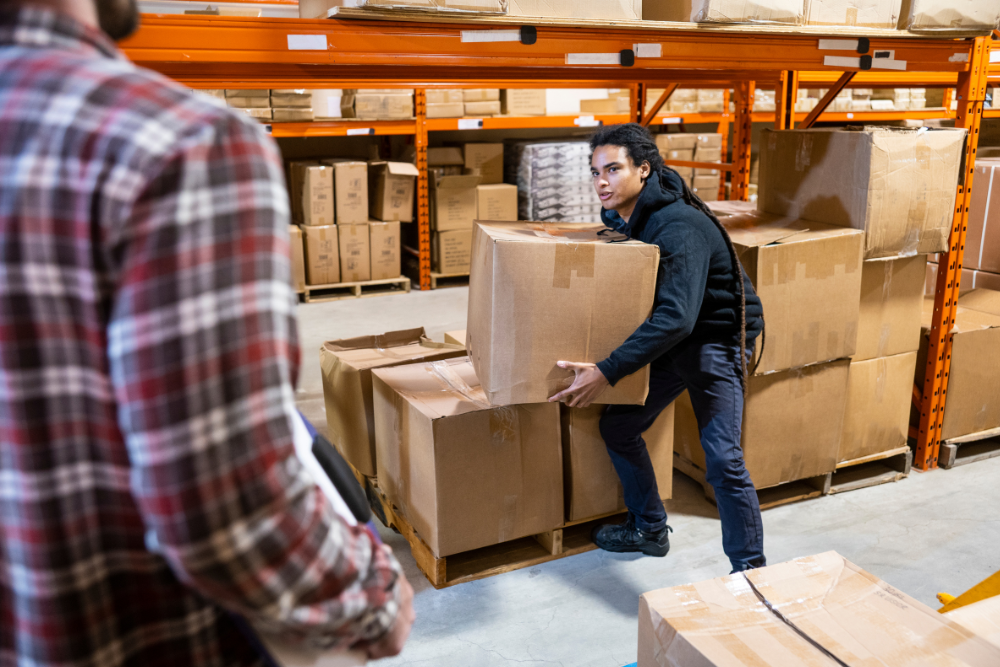
Back injuries are among the most common and costly workplace injuries in the United States. They show up in warehouses and on construction sites, but also in hospitals, retail stockrooms, restaurants and offices. Many start with a single awkward lift. Many more build up over months of lifting the same way, a little wrong, hundreds of times.
The good news is that most lifting injuries are preventable. Good technique, smart planning and the right equipment protect the spine far more than strength alone. This guide covers how lifting injures the back, how to lift safely step by step, and what employers can do to make safe lifting the default.
Why Lifting Injures the Back
The spine is built to carry load straight down through its column of vertebrae and discs. It handles bending and twisting well on their own, but poorly when they are combined with weight. Lifting goes wrong when the load is held far from the body, the back rounds forward, or the torso twists while carrying.
The most common lifting injuries include:
- Muscle strains and ligament sprains in the lower back, often from sudden or jerky lifts.
- Disc injuries, including bulging or herniated discs, when repeated forward bending puts pressure on the discs between vertebrae. A herniated disc can press on nerves and cause pain, numbness or weakness down the leg (sciatica).
- Cumulative strain from repetitive lifting, which can lead to chronic pain even when no single lift felt dangerous.
- Shoulder and neck injuries from lifting overhead or reaching across shelves.
Distance matters more than most people realize. A 20-pound box held at arm's length places several times more force on the lower back than the same box held close to the stomach. Speed, fatigue, slippery floors and awkward object shapes all add to the risk.
Plan the Lift Before You Lift
Most lifting injuries happen because the lift was not thought through. A few seconds of planning removes the surprises that cause sudden, awkward movements.
Before picking anything up, ask:
- How heavy is it? Tip one corner or push the object gently to test its weight. Check labels for weight markings.
- Is the load stable? Liquids slosh, contents shift, and boxes can be weaker than they look.
- Where is it going? Clear the path of cords, boxes and wet spots, and make sure the destination has room.
- Do I need help? If the object is heavy, bulky or an awkward shape, get a coworker or a mechanical aid before you start.
- Can the task be changed? Splitting a load into smaller containers, storing heavy items between knee and shoulder height, or moving the work closer to the worker all reduce strain.
Dress for the job as well. Non-slip footwear gives a stable base, and gloves improve grip on slick or rough surfaces.
Step-by-Step Safe Lifting Technique
These steps apply to most manual lifts from the floor or a low surface:
- Get close. Stand as near to the load as possible, with feet shoulder-width apart and one foot slightly ahead of the other for balance.
- Bend at the hips and knees, not the waist. Squat down while keeping your back in its natural, slightly arched position. Avoid rounding your spine forward.
- Get a firm grip. Use both hands and your whole palm, not just your fingertips. Use handholds where available.
- Tighten your core. Bracing your stomach muscles before you lift helps support the spine.
- Lift with your legs. Push up smoothly through your heels, letting your leg muscles do the work. Keep your head up and eyes forward.
- Keep the load close. Hold it against your body, between your waist and chest, for the entire carry.
- Don't twist. To change direction, pivot with your feet rather than turning your torso.
- Set it down the same way. Bend at the knees and hips to lower the load, keeping your back straight. Watch your fingers and toes.
Habits to avoid
- Jerking or lifting quickly to "get it over with"
- Lifting while twisted or reaching sideways
- Lifting heavy items above shoulder height or from below knee height when it can be avoided
- Carrying loads that block your view
- Lifting when tired, rushed or already sore
Team Lifts, Mechanical Aids and Load Limits
Good technique has limits. Some loads are simply too heavy, too large or too awkward for one person, no matter how carefully they lift.
Know the limits
The NIOSH Lifting Equation, the most widely used guideline for manual lifting, sets 51 pounds as the recommended maximum under ideal conditions: the load close to the body, at waist height, with no twisting and only occasional lifts. Real-world conditions are rarely ideal. Lifting from the floor, reaching, twisting or lifting frequently can cut the safe weight to well under half of that.
Lift as a team
When two or more people share a load:
- Choose one person to lead and call out each step ("lift on three").
- Pair people of similar height when possible so the load stays level.
- Lift, carry and set down together, at the same pace.
- Agree on the route and destination before lifting.
Use equipment
Mechanical aids remove much of the strain from lifting altogether. Common options include:
- Hand trucks, dollies and carts for boxes and supplies
- Pallet jacks and forklifts for heavy or stacked loads
- Lift tables and adjustable-height workstations that bring items to waist level
- Hoists, vacuum lifters and patient lifts in industrial and healthcare settings
- Conveyors and roller tables for repetitive material handling
Equipment only helps if it is close by, in working order and part of the normal routine. If workers have to hunt for a dolly, many will lift by hand instead.
What Employers Can Do
Safe lifting is not only an individual responsibility. The way work is designed has the biggest effect on how often people get hurt.
- Assess lifting tasks. Identify jobs with heavy, frequent or awkward lifts, and redesign them first.
- Store smart. Keep the heaviest and most-used items between knee and shoulder height.
- Provide and maintain equipment. Put carts, dollies and lift aids where the work happens.
- Train regularly. Cover safe lifting at onboarding and refresh it at least once a year, with hands-on practice rather than slides alone.
- Rotate tasks and schedule breaks. Fatigue makes good technique slip, especially late in a shift.
- Encourage early reporting. Make it easy for workers to report soreness, near misses and unsafe lifting tasks without fear of blame. A safety management system that tracks hazards, training and incidents helps spot patterns before they become injuries.
Know the Warning Signs
Mild muscle soreness after a physically demanding day often improves with rest. Some symptoms, however, call for prompt medical attention:
- Back pain that lasts more than a few weeks or keeps getting worse
- Pain that spreads down one or both legs
- Numbness, tingling or weakness in the legs or feet
- Pain that wakes you at night or does not ease with rest
- Loss of bladder or bowel control, which needs emergency care
These can be signs of a disc or nerve problem rather than a simple strain. Most back injuries improve with conservative care such as rest, physical therapy and activity changes. When symptoms persist, an evaluation by a specialist, such as an experienced spine surgeon in Houston or your local area, can pinpoint the cause and lay out treatment options, many of which are non-surgical.
Lift Smart, Protect Your Spine
A healthy back is easier to protect than to repair. Planning each lift, keeping loads close, lifting with the legs, avoiding twists and asking for help or equipment when a load is too much are simple habits that prevent most lifting injuries. When employers back those habits with good job design, the right tools and regular training, safe lifting becomes part of how the work gets done.