Fire extinguishers are one of the most common pieces of safety equipment found in workplaces, yet they're also among the most misunderstood. Many employees walk past a fire extinguisher every day without knowing what type it is, whether it's been recently inspected, or how to use it correctly in an emergency. For employers, that gap in understanding represents real risk — not just from a compliance standpoint, but from a life-safety one.
This guide covers everything organizations need to know about fire extinguishers from a workplace safety perspective: the different types available, where they should be located, how often they need to be inspected, who is responsible for maintaining them, and what federal regulations require.
Why Fire Extinguishers Matter in Workplace Safety
A fire extinguisher is often the difference between a minor incident that's contained in seconds and a fire that grows into a full-scale emergency. Small fires, when caught early, can frequently be extinguished before they spread, minimizing property damage, protecting employees, and preventing the need for a full building evacuation and fire department response.
However, extinguishers are only effective when three conditions are met: the right type of extinguisher is present for the hazard, it's been properly maintained and is in working condition, and employees actually know how and when to use it. A workplace can have extinguishers mounted on every wall and still be poorly protected if any one of these conditions is missing.
Types of Fire Extinguishers
Not all fires are the same, and using the wrong type of extinguisher can be ineffective at best and dangerous at worst. Fire extinguishers are classified by the type of fire they're designed to combat, and understanding these classifications is foundational to workplace fire safety.
Class A: Ordinary Combustibles
Class A extinguishers are designed for fires involving ordinary combustible materials such as wood, paper, cloth, rubber, and many plastics. These are common in office environments, warehouses, and general commercial spaces where such materials are present.
Class B: Flammable Liquids and Gases
Class B extinguishers target fires involving flammable liquids and gases, including gasoline, oil, grease, and solvents. These are essential in workplaces like automotive shops, manufacturing facilities, and any location where flammable liquids are stored or used.
Class C: Electrical Fires
Class C extinguishers are rated for fires involving energized electrical equipment, such as wiring, circuit breakers, and machinery. Using water or a Class A extinguisher on an electrical fire can create a serious shock hazard, which is why Class C-rated agents, typically non-conductive, are required in these situations.
Class D: Combustible Metals
Class D extinguishers are specialized for fires involving combustible metals like magnesium, titanium, and sodium. These are far less common in general workplaces but are critical in specific industrial and laboratory settings that work with reactive metals.
Class K: Cooking Oils and Fats
Class K extinguishers are designed specifically for commercial kitchen fires involving cooking oils, fats, and grease. Standard extinguishers are ineffective and can even be dangerous on these fires, since they can cause hot oil to splatter; Class K agents work by cooling the fuel and creating a soap-like barrier that suppresses re-ignition.
Multi-Class Extinguishers
Many workplaces use multi-purpose extinguishers rated for more than one class of fire, commonly labeled ABC extinguishers, which cover ordinary combustibles, flammable liquids, and electrical fires in a single unit. These are popular in general commercial and office settings because they address the majority of fire risks likely to be encountered without requiring multiple extinguisher types throughout the facility.
Fire Extinguisher Placement Requirements
Where extinguishers are located throughout a facility is just as important as having them at all. Poor placement can mean the difference between an employee reaching an extinguisher in seconds versus not being able to find one in time.
Travel Distance Requirements
For Class A hazards, extinguishers generally must be placed so that no employee has to travel more than 75 feet to reach one. For Class B hazards, the maximum travel distance is typically 50 feet, reflecting the faster-spreading nature of flammable liquid fires. These distances are maximums, not targets — many safety professionals recommend closer spacing in high-traffic or higher-risk areas.
Mounting Height and Visibility
Extinguishers should be mounted so they are visible, unobstructed, and readily accessible in an emergency, without needing to move furniture, equipment, or stock to reach them. Extinguishers weighing less than 40 pounds should generally be mounted with the top no higher than 5 feet from the floor, while those weighing more should be mounted no higher than about 3.5 feet, ensuring they can be quickly and safely removed by employees of varying heights and strength levels.
Placement Near Specific Hazards
Beyond general facility coverage, extinguishers should be specifically located near areas of elevated fire risk, such as near flammable liquid storage, electrical panels, commercial kitchens, and areas with significant combustible material storage. In these zones, the appropriate class of extinguisher should be placed close enough to respond quickly if an incident occurs in that specific area.
Signage and Accessibility
Clear, visible signage should mark the location of each extinguisher, particularly in large facilities or in areas where the extinguisher itself might be partially obstructed from view. Extinguishers should never be blocked by equipment, inventory, or furniture, and pathways to them should remain clear at all times.
Fire Extinguisher Inspection Requirements
Simply having extinguishers in place isn't enough — they need to be properly maintained to ensure they'll function correctly when needed. Inspection requirements generally fall into three tiers: monthly visual inspections, annual maintenance checks, and periodic hydrostatic testing.
Monthly Visual Inspections
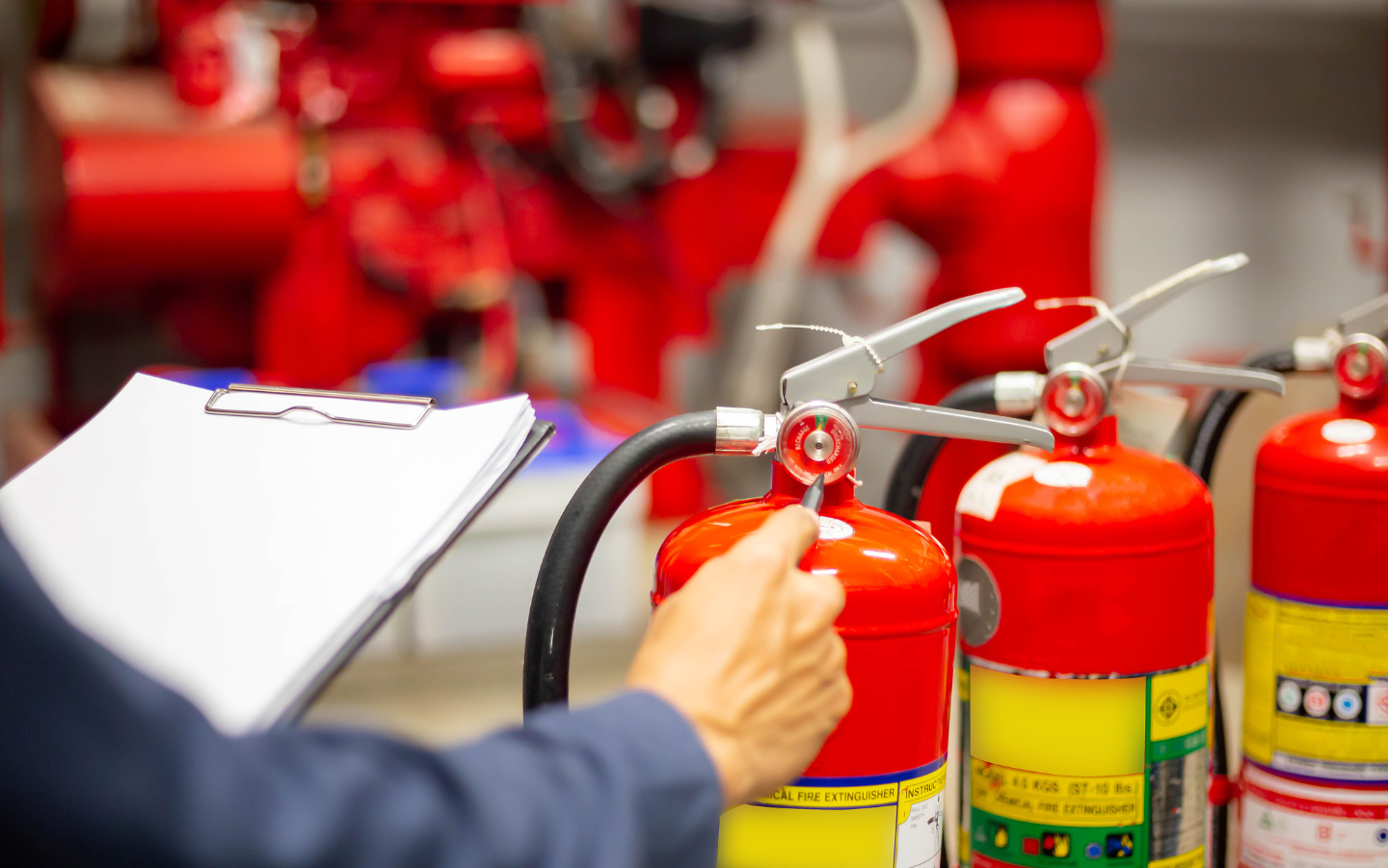
Employers, or a designated responsible employee, should conduct a monthly visual inspection of every extinguisher in the facility. This inspection typically checks that the extinguisher is in its designated location, is fully visible and unobstructed, has a readable label, shows a full charge based on the pressure gauge, has no visible damage such as dents, rust, or corrosion, and has an intact pin and tamper seal. Many facilities use a tag system, where the inspector initials and dates a tag attached to the extinguisher each month, creating a documented history of inspections.
Annual Maintenance Inspections
In addition to monthly visual checks, extinguishers require a more thorough annual maintenance inspection, generally conducted by a qualified fire protection professional or certified technician. This inspection goes beyond a visual check to verify the extinguisher's internal condition, confirm it meets manufacturer specifications, and ensure it will function properly if needed. Annual inspections are typically documented with a tag indicating the date of service and the technician or company that performed it.
Hydrostatic Testing
Certain extinguisher types require periodic hydrostatic testing, which involves pressure-testing the extinguisher's cylinder to ensure it can safely hold its rated pressure. The required testing interval varies by extinguisher type; for example, many dry chemical extinguishers require testing every 12 years, while some other types require testing at different intervals. Extinguishers that fail hydrostatic testing must be removed from service and either repaired or replaced.
Recordkeeping
Maintaining thorough, organized records of all inspections, maintenance, and testing is essential, both for regulatory compliance and for internal accountability. Inspection tags attached to each extinguisher provide a quick reference, but many organizations also maintain a centralized log or digital tracking system covering all extinguishers across a facility or multiple locations.
Regulatory Requirements for Workplace Fire Extinguishers
OSHA Requirements
In the United States, OSHA's standard on portable fire extinguishers (29 CFR 1910.157) establishes the core workplace requirements. This standard covers the selection, distribution, use, and maintenance of extinguishers in general industry workplaces. Employers who provide portable fire extinguishers for employee use must ensure they are properly mounted, located, and identified so they're readily accessible, and must maintain them in a fully charged and operable condition.
The standard also requires employers to conduct the monthly visual inspection and annual maintenance check described above, and to keep records of annual maintenance dates for at least one year after the last entry, or maintain a certification record documenting the required maintenance activities.
NFPA 10 Standard
The National Fire Protection Association's NFPA 10 standard, "Standard for Portable Fire Extinguishers," provides the detailed technical requirements that many of OSHA's provisions reference or align with. NFPA 10 covers extinguisher selection, placement distances, inspection frequency, maintenance procedures, and hydrostatic testing intervals in much greater technical detail than OSHA's general industry standard, and it's frequently incorporated by reference into state and local fire codes.
Employee Training Requirements
OSHA requires that employers provide employees with an educational program regarding the general principles of fire extinguisher use and the hazards involved with incipient-stage firefighting when extinguishers are made available for employee use. Additionally, where employers expect employees to actually use extinguishers to fight fires, hands-on training must be provided upon initial employment and at least annually thereafter.
Employer Options: Total Evacuation Policy
Employers do have an alternative option under OSHA's standard: if an employer's policy is to have all employees evacuate immediately upon the sound of a fire alarm rather than attempting to fight fires themselves, and no employee is expected to use extinguishers, certain training and maintenance provisions of the standard may not apply. However, this approach still requires the employer to have a written fire prevention plan and generally still requires functioning extinguishers to be available for other purposes, such as use by responding fire personnel.
Common Fire Extinguisher Compliance Mistakes
Wrong Extinguisher Type for the Hazard
One of the most common and dangerous mistakes is having the wrong class of extinguisher available for the hazards actually present in a given area, such as relying on a standard Class A extinguisher near a commercial kitchen fryer where a Class K extinguisher is actually required.
Skipping Monthly Inspections
Monthly visual inspections are easy to overlook, especially in low-traffic areas of a facility, but skipping them means potential problems, like a slowly discharging pressure gauge or a damaged hose, can go unnoticed for months at a time.
Blocked or Obscured Extinguishers
Extinguishers frequently get blocked by stacked inventory, parked equipment, or furniture rearrangement, especially in warehouses and storage areas. Regular facility walkthroughs should specifically check that extinguisher access remains clear.
Inadequate Employee Training
Even a properly maintained, correctly placed extinguisher provides little value if employees don't know how to use it. Training should go beyond a single onboarding session and be reinforced periodically, ideally with actual hands-on practice rather than lecture-only formats.
Best Practices for a Strong Fire Extinguisher Program
Conduct a Facility Fire Risk Assessment
Rather than distributing extinguishers uniformly, organizations benefit from assessing fire risks area by area, identifying where flammable liquids, electrical equipment, cooking operations, or high combustible material loads exist, and ensuring the right extinguisher types and quantities are placed accordingly.
Assign Clear Ownership
Designate a specific person or team responsible for monthly inspections, scheduling annual maintenance, and coordinating hydrostatic testing when due. Without clear ownership, inspection tasks often fall through the cracks.
Integrate Extinguisher Checks Into Broader Safety Walkthroughs
Rather than treating extinguisher inspections as an entirely separate task, many organizations fold monthly checks into broader safety walkthroughs, improving consistency and ensuring the task doesn't get deprioritized.
Reinforce Training Regularly
Annual hands-on training, ideally using training extinguishers or simulation tools, helps employees build genuine muscle memory and confidence rather than relying on theoretical knowledge alone.
Frequently Asked Questions
1. How often does a fire extinguisher need to be inspected, and who is responsible for doing it?
Fire extinguisher inspection follows a layered schedule involving different levels of scrutiny at different intervals, and understanding this structure is essential for maintaining compliance and genuine readiness. At the most frequent level, a visual inspection must be conducted monthly, and this can typically be performed by a trained employee rather than requiring an outside contractor. This monthly check confirms that the extinguisher is in its designated location, is unobstructed and visible, has a functioning and legible label, shows a full charge on its pressure gauge, has no signs of physical damage such as dents or corrosion, and has an intact safety pin and tamper seal. Beyond the monthly visual check, a more thorough annual maintenance inspection is required, and this is generally performed by a qualified fire protection service company or certified technician with specialized training and equipment, since it involves a deeper examination of the extinguisher's internal components and mechanisms that goes beyond what a visual check alone can verify. Finally, certain extinguisher types require periodic hydrostatic testing at intervals that vary based on the extinguisher's construction and the agent it contains, which tests the physical integrity of the pressurized cylinder itself; this testing is performed by specialized service providers with the necessary equipment and certification. Organizations should maintain clear documentation of all three inspection levels, since incomplete or missing records are one of the most common compliance gaps identified during fire safety audits or regulatory inspections.
2. What happens if an employee uses the wrong type of fire extinguisher on a fire?
Using the wrong type of fire extinguisher can range from simply ineffective to genuinely dangerous, depending on the specific mismatch between the extinguisher and the fire involved, which is precisely why proper classification and placement matter so much in workplace fire safety programs. The most commonly cited dangerous scenario involves using a water-based or standard Class A extinguisher on an energized electrical fire, since water conducts electricity and can create a serious risk of electrical shock to the person operating the extinguisher, potentially turning a contained fire into a life-threatening situation for the responder. Similarly, using a standard extinguisher, including many multi-purpose ABC units, on a commercial kitchen grease fire can be dangerous because the force of the extinguishing agent can cause hot burning oil to splatter and spread rather than being properly smothered, which is exactly why Class K extinguishers exist as a specialized solution using an agent designed to cool the oil and form a protective barrier against re-ignition. Beyond safety risks, using the wrong extinguisher type can also simply fail to extinguish the fire at all, allowing it to continue growing while the person attempting to fight it wastes valuable time and the extinguisher's limited discharge capacity. This underscores why proper workplace fire safety training doesn't just cover how to operate an extinguisher mechanically, but also emphasizes fire classification and helps employees quickly identify which type of extinguisher is appropriate for the specific hazard they're facing, along with clear guidance that when in doubt, or when a fire is spreading beyond the incipient stage, evacuation and calling emergency services takes priority over attempting to fight the fire.
3. Are employers legally required to train employees on how to use fire extinguishers?
The training requirement depends significantly on the employer's chosen fire response policy, and understanding this distinction is important for organizations determining their compliance obligations. Under OSHA's standard for portable fire extinguishers, if an employer expects or allows employees to use extinguishers to fight incipient-stage fires, the employer is required to provide an educational program covering the general principles of extinguisher use and the hazards associated with attempting to fight a fire, and this general education must occur when the employee is first assigned to a job where extinguisher use might be expected. Beyond this general education, if the employer specifically designates certain employees to use extinguishers as part of an emergency response plan, those designated employees must receive hands-on training in the actual use of the extinguisher equipment available in the workplace, both at the time of initial assignment and at least annually thereafter, ensuring skills don't atrophy over time. However, employers do have an alternative compliance path: if the organization's official policy is that all employees are required to evacuate immediately upon any fire alarm activation, with no employee expected or permitted to attempt firefighting, some of the specific training and maintenance provisions tied to employee extinguisher use may not apply in the same way. That said, even under a total evacuation policy, most employers still choose to maintain functional extinguishers throughout the facility, both because local fire codes often still require them regardless of the employer's internal policy, and because they remain valuable for use by professional firefighters or other emergency responders once they arrive. Given the complexity and potential liability involved, many organizations choose to provide at least basic extinguisher training to all employees as a best practice, even beyond the specific minimum regulatory requirements that might technically apply to their situation.
4. How many fire extinguishers does a workplace actually need, and does it depend on the size of the facility?
Yes, the required number and placement of fire extinguishers is directly tied to the size of the facility, the layout of the space, and the specific fire hazards present in different areas, rather than being a single fixed number that applies universally. The primary driver behind extinguisher quantity requirements is travel distance: for ordinary combustible material hazards, extinguishers generally need to be placed so no employee has to travel more than about 75 feet to reach one, while for flammable liquid hazards, the maximum travel distance typically drops to around 50 feet, given how much more quickly these fires can spread and intensify. In practical terms, this means a large, open warehouse floor will require multiple extinguishers spaced throughout the space to keep every point within the required travel distance, while a small office suite might be adequately covered by just one or two units strategically placed near exits or common areas. Beyond the baseline travel-distance requirement, facilities with specific elevated-risk zones, such as flammable liquid storage rooms, electrical equipment rooms, commercial kitchens, or areas with heavy combustible material storage, typically need additional, appropriately rated extinguishers placed specifically to address those localized risks, on top of the general facility coverage. Because these requirements interact with a facility's specific floor plan, storage patterns, and hazard profile, many organizations benefit from having a qualified fire protection professional conduct a facility assessment to determine the appropriate type, quantity, and placement of extinguishers, rather than attempting to calculate coverage requirements independently, particularly for larger or more complex facilities where the consequences of under-coverage can be significant.
5. What should be done with a fire extinguisher that fails inspection or reaches the end of its service life?
An extinguisher that fails inspection, whether during a monthly visual check, an annual maintenance inspection, or hydrostatic testing, should be immediately removed from service and taken out of its mounted location so employees don't mistakenly rely on equipment that isn't functional in an emergency. Depending on the nature of the failure, the extinguisher may either be repairable through professional servicing, such as recharging a unit that has lost pressure or replacing a damaged hose or handle, or it may need to be permanently retired if it has significant physical damage, has failed hydrostatic testing due to structural concerns with the cylinder, or has simply reached the end of its manufacturer-specified service life. It's important that a failed or removed extinguisher not simply be discarded in regular trash, since pressurized cylinders, even empty ones, and the chemical agents inside many extinguishers require proper disposal procedures; most fire protection service companies that handle extinguisher maintenance and testing also offer proper disposal or recycling services as part of their standard offerings. Whenever an extinguisher is removed from service for any reason, it's critical that it be promptly replaced with a functional unit of the appropriate type and rating for that location, since leaving a gap in fire protection coverage, even temporarily, undermines the facility's overall fire safety readiness and could create a compliance gap if a fire occurs during that window. Organizations should build a clear internal process for handling failed extinguishers, including who is authorized to arrange for professional servicing or replacement, how quickly a replacement unit must be installed, and how the removal, service, and replacement are documented, ensuring that a failed inspection triggers a fast, reliable corrective action rather than being addressed on an ad hoc basis whenever someone happens to notice.