.png)
Workplace safety does not improve because of a single training session, a new policy, or a safety slogan on the wall. Sustainable safety performance is built through systems. The most resilient organizations don’t rely on reactive fixes — they design environments, behaviors, accountability structures, and feedback loops that prevent injuries before they happen.
The 5 E’s of Workplace Safety — Engineering, Education, Enforcement, Engagement, and Evaluation — provide a structured framework for building that system. Each “E” addresses a different dimension of risk management. Together, they create layered protection that strengthens both compliance and culture.
When one of the five is weak, safety performance becomes fragile. When all five work in alignment, safety becomes embedded in operations.
1. Engineering: Designing Risk Out of the Workplace
Engineering is the most powerful of the five because it addresses hazards at the source. It focuses on physical design, equipment safeguards, process controls, and environmental modifications that reduce exposure before behavior becomes a factor.
Engineering solutions include:
- Machine guarding and interlocks
- Ventilation systems for airborne contaminants
- Ergonomic workstation design
- Slip-resistant flooring
- Automated shutoff mechanisms
- Noise dampening enclosures
When organizations rely solely on administrative rules or PPE without evaluating engineering controls, they shift responsibility onto workers. Engineering controls, by contrast, reduce dependence on perfect human behavior.
A mature safety program consistently reviews equipment upgrades, process redesigns, and technology improvements that eliminate or significantly reduce hazard exposure.
2. Education: Building Knowledge and Competence
Education ensures that employees understand hazards, procedures, and expectations. But effective education goes beyond compliance-based training modules.
It includes:
- Role-specific safety instruction
- Hands-on demonstrations
- Hazard recognition exercises
- Scenario-based learning
- Leadership safety training
Education is not a one-time onboarding activity. Work environments evolve, equipment changes, and new risks emerge. Ongoing learning reinforces safe decision-making and prevents complacency.
The most effective organizations tie education to real-world risk data. For example, if near-miss reports show an increase in hand injuries, targeted training reinforces glove selection and safe handling procedures.
Knowledge reduces uncertainty. Clarity improves decision-making under pressure.
3. Enforcement: Establishing Consistent Accountability
Even well-designed systems and strong training programs require reinforcement. Enforcement ensures that safety expectations are consistently upheld.
This does not mean punitive management. Instead, enforcement establishes:
- Clear safety rules
- Documented disciplinary procedures
- Supervisor accountability
- Consistent corrective action processes
When rules are applied inconsistently, credibility erodes. Employees quickly recognize when production priorities override safety expectations.
Strong enforcement aligns leadership behavior with policy. Supervisors who model compliance send a powerful message. Accountability reinforces standards and prevents normalization of deviance — the gradual acceptance of unsafe practices.
Enforcement is not about punishment; it is about protecting the integrity of the safety system.
4. Engagement: Creating Shared Ownership
Engagement transforms safety from a management directive into a collective responsibility. When employees feel ownership, reporting increases and prevention becomes proactive.
Engagement includes:
- Near-miss reporting programs
- Safety committees
- Toolbox talks
- Behavior-based observation programs
- Recognition for safe performance
Employees on the front lines often see hazards first. If they do not feel empowered to speak up, risk remains hidden.
Engaged workplaces foster psychological safety. Workers trust that reporting hazards will lead to improvement, not blame.
Organizations that prioritize engagement consistently report stronger leading indicators — more hazard identification, faster corrective action closure, and earlier risk detection.
5. Evaluation: Measuring and Improving Continuously
Evaluation ties the entire framework together. Without measurement, organizations cannot determine whether their safety systems are effective.
Evaluation includes both lagging and leading indicators:
- TRIR and DART rates
- Near-miss frequency
- Audit completion rates
- Corrective action closure times
- Training compliance metrics
Evaluation requires structured data collection and analysis. It demands more than annual reporting — it requires continuous review.
High-performing organizations conduct trend analysis across departments, job roles, and facilities. They identify patterns, assess emerging risks, and adjust strategies accordingly.
Evaluation ensures that safety programs remain dynamic rather than static.
How the 5 E’s Work Together
The 5 E’s are interconnected. Weakness in one area places strain on the others.
For example:
- Strong education without enforcement reduces credibility.
- Engineering controls without engagement may go unused.
- Enforcement without engagement damages trust.
- Evaluation without engineering improvements stalls progress.
When all five are aligned, safety systems become self-reinforcing. Hazards are engineered out, employees are trained to recognize remaining risks, standards are upheld consistently, employees actively participate, and performance is continuously measured.
This layered approach reduces reliance on luck and strengthens resilience.
Applying the 5 E’s Across Industries
The framework applies across industries, though implementation may vary.
Manufacturing
Engineering improvements may focus on machine guarding and automation, while evaluation analyzes injury trends by shift or production line.
Construction
Engagement and education often play larger roles due to dynamic jobsite environments and subcontractor coordination.
Oil & Gas
Engineering and enforcement are critical due to high-consequence hazards, with evaluation driven by permit systems and inspection data.
Logistics and Warehousing
Ergonomics, traffic management systems, and fatigue education may dominate engineering and education priorities.
The flexibility of the 5 E’s makes the model scalable across operational complexity.
Technology as a Force Multiplier
Modern EHS platforms enhance each “E” by:
- Tracking engineering inspections
- Managing training compliance
- Documenting enforcement actions
- Enabling near-miss reporting
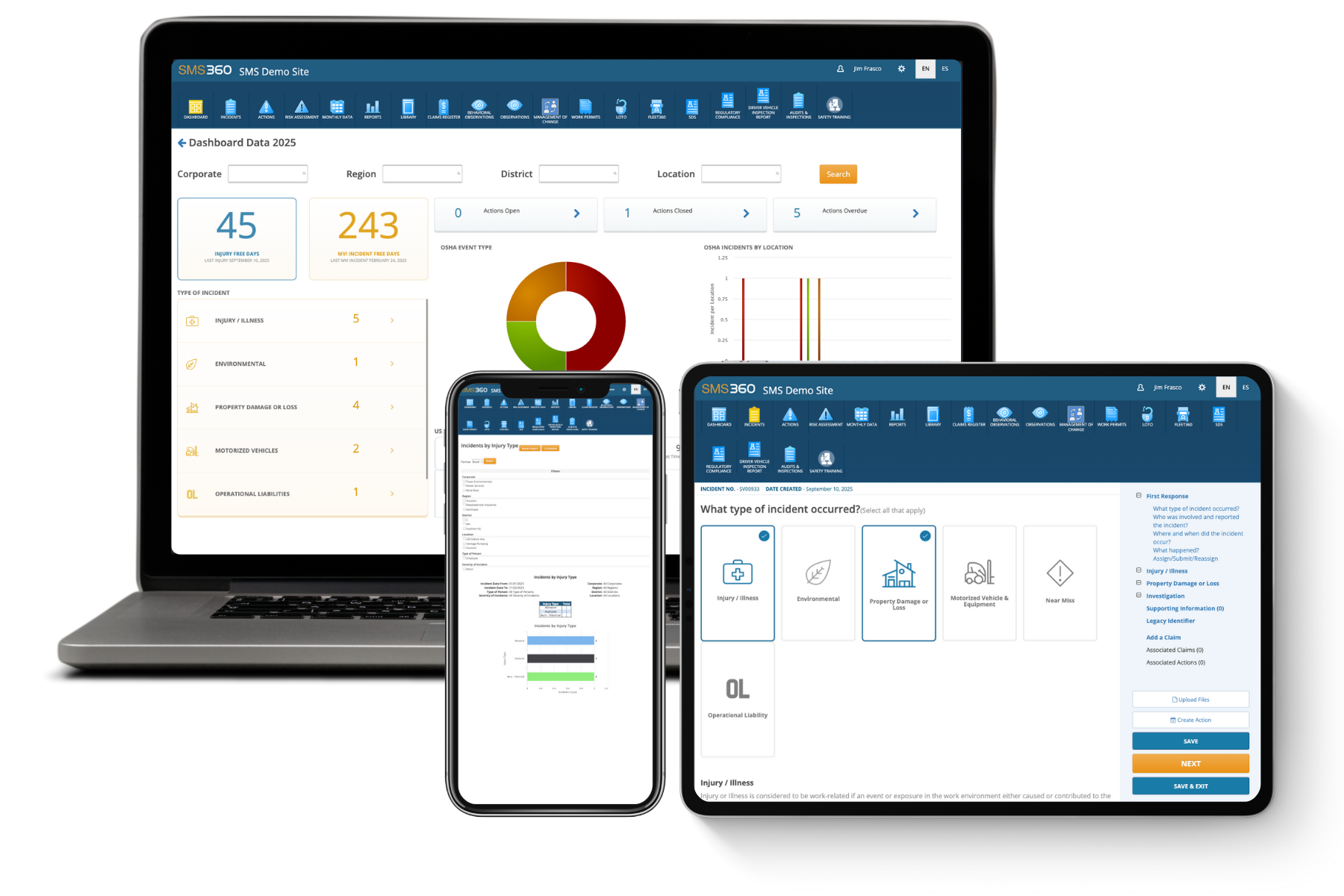
- Providing real-time dashboards for evaluation
Technology does not replace leadership — it strengthens visibility and accountability.
When data from all five dimensions is centralized, leadership gains a holistic view of system performance.
Moving from Compliance to Culture
The 5 E’s framework shifts safety from a compliance requirement to a strategic operating principle.
Compliance ensures minimum standards are met. Culture ensures standards are lived daily.
Organizations that invest in engineering improvements, reinforce education, apply fair enforcement, foster engagement, and continuously evaluate performance build safety systems that endure growth, change, and operational pressure.
Injury prevention becomes embedded — not episodic.
FAQs About the 5 E’s of Workplace Safety
1. Are the 5 E’s a regulatory requirement?
No, they are a strategic framework that supports compliance while strengthening safety culture and operational resilience.
2. Which of the 5 E’s is most important?
Engineering often has the strongest preventive impact, but sustainable performance requires balance across all five.
3. How do leading indicators fit into this model?
Leading indicators fall under Evaluation and Engagement, helping organizations detect risk before injuries occur.
4. Can small organizations apply the 5 E’s?
Yes. Even smaller operations can strengthen engineering controls, improve education, enforce standards, encourage engagement, and evaluate performance consistently.
5. How can EHS software support the 5 E’s framework?
EHS platforms centralize data across inspections, training, corrective actions, incident tracking, and reporting — providing visibility that supports continuous improvement across all five elements.