Machine guarding violations are among OSHA's most cited standards every year. Here is how to build a safeguarding program that actually protects your workers and keeps your organization compliant.
Every year, thousands of workers are injured by unguarded or inadequately guarded machinery — amputations, crush injuries, lacerations, and fatalities that are almost always preventable. Machine safeguarding is one of the most fundamental requirements in industrial safety, and yet it remains one of the most frequently violated OSHA standards. For safety managers in manufacturing, construction, food processing, logistics, and any other industry where workers interact with powered machinery, understanding safeguarding requirements and building a systematic program is not optional — it is a baseline obligation.
What Is Machine Safeguarding?
Machine safeguarding refers to the barriers, devices, and procedures used to protect workers from the hazardous parts of machinery — points of operation, power transmission components, and other moving parts that can cause injury on contact. The goal is to prevent workers from coming into contact with dangerous machine parts during normal operation, maintenance, and servicing.
Types of Machine Guards
OSHA recognizes several categories of safeguarding methods, each suited to different machine types and operational requirements.
Fixed guards are permanent barriers that enclose hazardous areas and cannot be removed without tools. They provide consistent protection during normal operations but do not accommodate frequent access to the guarded area.
Interlocked guards are connected to the machine's control system so that the machine cannot operate when the guard is open or removed. They allow access for maintenance while preventing operation with the guard bypassed.
Adjustable guards can be repositioned to accommodate different sizes or types of work while still providing protection. They require more attention to ensure they are properly adjusted and not bypassed.
Self-adjusting guards automatically move to allow the workpiece to pass through while maintaining a barrier against worker contact. They are common on woodworking equipment and certain metalworking machines.
Presence-sensing devices — including light curtains, laser scanners, and pressure-sensitive mats — detect when a worker enters a hazardous zone and automatically stop the machine. These devices are increasingly common in automated manufacturing environments.
OSHA Safeguarding Standards
OSHA's machine guarding standards are found primarily in 29 CFR 1910.212 (general machine guarding for general industry), 29 CFR 1910.213 (woodworking machinery), 29 CFR 1910.217 (mechanical power presses), and 29 CFR 1926.300 (hand and power tools in construction). The general industry standard at 1910.212 establishes the baseline requirement: one or more methods of machine guarding shall be provided to protect workers from hazards such as those created by points of operation, ingoing nip points, rotating parts, flying chips, and sparks.
Common OSHA Safeguarding Violations
The most frequently cited safeguarding violations include missing or inadequate point-of-operation guards, guards that have been removed and not replaced, guards that are damaged or improperly secured, inadequate guarding of power transmission components such as belts, pulleys, chains, and gears, and failure to implement lockout/tagout procedures before performing maintenance on guarded equipment. Understanding where your organization is most likely to be cited is an important starting point for any safeguarding program assessment.
Building a Machine Safeguarding Program
Machine Inventory and Hazard Assessment
The first step in any safeguarding program is a complete inventory of all powered machinery in the workplace, followed by a hazard assessment for each machine. The assessment should identify all hazardous parts and motion types, evaluate the adequacy of existing guarding, assess the risk level associated with any unguarded or inadequately guarded hazards, and prioritize corrective actions. This process should be documented thoroughly — both to guide the corrective action program and to demonstrate due diligence in the event of an inspection or incident.
Guard Selection and Installation
Selecting the right type of guard for each machine requires consideration of the specific hazard, the operational requirements of the machine, and the frequency with which workers need to access the guarded area. Guards must be designed so they do not create additional hazards themselves — a guard with sharp edges or one that obstructs visibility in ways that cause workers to bypass it creates more risk than it eliminates. Installation should be performed by qualified personnel and verified against applicable standards before the machine returns to service.
Worker Training
Workers who operate or maintain guarded machinery must be trained on the purpose of each guard, how to verify that guards are in place and functioning before starting work, what to do if a guard is missing or damaged, and the lockout/tagout procedures that apply when guards must be temporarily removed for maintenance. Training must be documented and refreshed whenever new equipment is introduced, job assignments change, or an incident or near-miss reveals a training gap.
Inspection and Maintenance of Guards
Guards require regular inspection to verify they remain in place, undamaged, and properly secured. Inspection programs should include pre-shift checks by operators, periodic formal inspections by safety personnel, and immediate reporting procedures for any guard that is found missing, damaged, or bypassed. Corrective actions for identified deficiencies should be tracked through to completion, not simply noted and forgotten.
How SMS360 Supports Safeguarding Programs
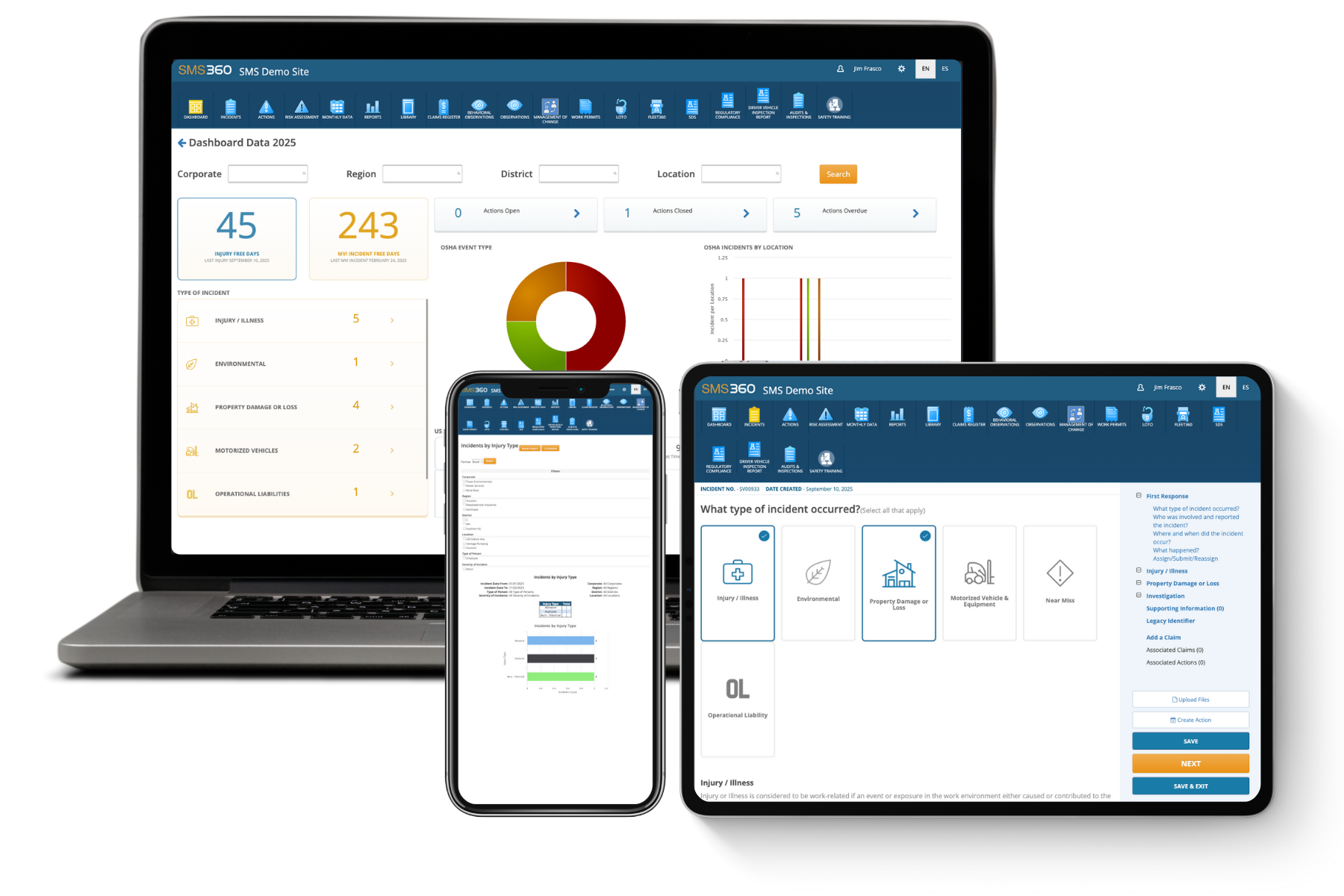
SMS360's inspection and audit tools allow safety managers to build customized inspection checklists for each piece of machinery, assign and track corrective actions when deficiencies are identified, maintain a complete history of inspection results per asset, and generate compliance reports for leadership and regulatory purposes. Combined with SMS360's training management capabilities, organizations can ensure that every operator and maintenance worker has completed required safeguarding training and that those records are current and accessible when needed.
Frequently Asked Questions About Machine Guarding
What is a point of operation and why does it require guarding?
The point of operation is the area of a machine where work is actually performed — where cutting, shaping, boring, or forming takes place. It is the location where the worker must come closest to the machine's hazardous action, and therefore the area of greatest injury risk. OSHA requires that all points of operation be guarded to prevent any part of a worker's body from entering the danger zone during the machine's operating cycle. Point-of-operation guarding is particularly critical on equipment like power presses, shears, saws, and drilling machines, where the consequence of contact can be immediate and severe.
Can workers remove machine guards for maintenance?
Yes, but only under strictly controlled conditions. When a guard must be removed to perform maintenance, inspection, or repair work, the machine must first be de-energized and locked out in accordance with OSHA's lockout/tagout standard (29 CFR 1910.147). This means that all energy sources — electrical, pneumatic, hydraulic, mechanical, thermal — must be isolated and locked in the off position before the guard is removed, and the lock must remain in place until the work is complete and the guard has been reinstalled. Under no circumstances should a guard be removed while the machine is energized or capable of unexpected startup.
What are the most common injuries caused by inadequate machine guarding?
Amputations are the most severe and well-publicized injuries associated with inadequate guarding, but they represent only a portion of guarding-related injuries. Crush injuries occur when a worker's body part becomes caught in a nip point — the area where two rotating parts come together, such as between a belt and pulley. Lacerations result from contact with cutting or shearing surfaces. Abrasion injuries occur from contact with rotating rough surfaces. Struck-by injuries result from flying debris or ejected workpieces. Eye injuries from chips, sparks, and coolant are also common in inadequately guarded machining operations. The severity of guarding-related injuries means that even a single incident can have life-altering consequences for the injured worker and significant legal and financial consequences for the employer.
How do presence-sensing devices differ from physical guards?
Physical guards create a physical barrier between the worker and the hazardous machine part — the worker simply cannot reach the danger zone without removing the guard. Presence-sensing devices, by contrast, detect when a worker enters the hazardous zone and automatically stop the machine before contact can occur. Light curtains, for example, project an array of infrared beams across the access point; breaking any beam triggers an immediate machine stop. Presence-sensing devices are particularly useful in applications where frequent access to the machine area is required, making a physical guard impractical. However, they require regular testing and calibration to ensure they function reliably, and they must be properly integrated with the machine's control system so that bypassing the device is not possible.
How should near-miss events related to machine guarding be handled?
Near-miss events — situations where a worker came close to contact with an unguarded or inadequately guarded machine part but was not injured — should be treated with the same seriousness as actual incidents. They are, in effect, warnings that a system failure has occurred and that an injury is a matter of timing rather than a matter of whether. Near-misses should be reported immediately, investigated to identify the root cause (was the guard missing, damaged, bypassed, or was a worker working outside established procedures?), and used to drive corrective action. Organizations that track and analyze near-miss data systematically find that they can identify and correct hazardous conditions before they result in injuries. Safety management software that makes near-miss reporting easy and anonymous — and that ties reports to corrective action workflows — dramatically improves the quality of near-miss data available to safety managers.
.png)