
ESG reporting is no longer optional for most organizations. Here is how dedicated ESG software — and an integrated EHS platform — helps companies collect better data, meet disclosure requirements, and turn sustainability commitments into operational reality.
Environmental, Social, and Governance — ESG — has moved from the periphery of corporate strategy to its center in a remarkably short time. Investors, regulators, customers, and employees now evaluate organizations not just on financial performance but on how they manage their environmental footprint, treat their workers, and govern their operations responsibly. For safety and operations leaders, this shift creates both new obligations and new opportunities: the safety and health data your organization already collects is a core input to ESG reporting, and a strong EHS program is increasingly recognized as a material driver of ESG performance.
What Is ESG and Why Does It Matter for Safety Leaders?
ESG is a framework for evaluating a company's performance on three dimensions. Environmental criteria assess how a company manages its impact on the natural world — energy use, emissions, waste, water consumption, and environmental compliance. Social criteria assess how a company manages relationships with its workers, supply chain, communities, and customers — including workplace health and safety, labor practices, training and development, and diversity. Governance criteria assess leadership quality, executive accountability, transparency, and ethical business conduct.
The Safety Connection
Workplace health and safety sits squarely within the social pillar of ESG. Incident rates, injury severity, OSHA compliance history, worker health programs, and safety culture metrics are all material ESG data points that investors and reporting frameworks explicitly require. For safety managers, this means that the work you do every day — reducing injuries, maintaining compliance, building a safety culture — has direct ESG implications. And increasingly, organizations are being asked to demonstrate and quantify that work through formal ESG disclosures.
Key ESG Reporting Frameworks
Several major frameworks govern how organizations report on their ESG performance, and understanding which apply to your organization is the first step to effective ESG data management.
GRI Standards
The Global Reporting Initiative (GRI) standards are the most widely used ESG reporting framework worldwide. GRI includes specific disclosure requirements for occupational health and safety (GRI 403), covering management approach to occupational health and safety, hazard identification processes, work-related incident rates, and worker participation in safety programs. Organizations reporting under GRI must provide quantitative data on recordable incidents, lost time injuries, and fatalities, along with qualitative description of their safety management systems.
SASB Standards
The Sustainability Accounting Standards Board (SASB) has developed industry-specific standards that identify the ESG issues most likely to be financially material for companies in each sector. SASB standards for industries such as construction, manufacturing, transportation, and healthcare include specific metrics related to injury and illness rates, lost time, and safety management system certifications.
SEC Climate Disclosure Rules
In the United States, the SEC has been developing climate-related disclosure requirements that will affect many public companies. While primarily focused on environmental metrics, these rules reflect the broader trend toward mandatory, standardized ESG reporting that is reshaping how organizations must collect and document sustainability data.
How ESG Software Helps
Centralized Data Collection
ESG reporting requires pulling data from across the organization — environmental compliance records, safety incident data, training records, workforce statistics, and governance documentation. Without a system that centralizes this information, the annual ESG reporting process becomes a time-consuming and error-prone exercise in manual data aggregation. ESG software provides a structured repository for all relevant data, with defined collection workflows, data validation, and audit trails.
Streamlined Reporting
ESG software can map organizational data to the specific disclosure requirements of applicable frameworks, pre-populating reports with the relevant metrics and flagging gaps where data is missing or incomplete. This dramatically reduces the time and effort required to produce audit-quality ESG reports and reduces the risk of errors or omissions that could create regulatory or reputational exposure.
Integration With EHS Data
The most effective ESG programs are built on the foundation of a strong EHS data infrastructure. Organizations that manage their safety data through a centralized EHS platform — tracking incidents, inspections, training, and corrective actions in a single system — have a significant advantage in ESG reporting because the data they need for social pillar disclosures is already collected, organized, and ready to surface.
How SMS360 Connects to ESG Performance
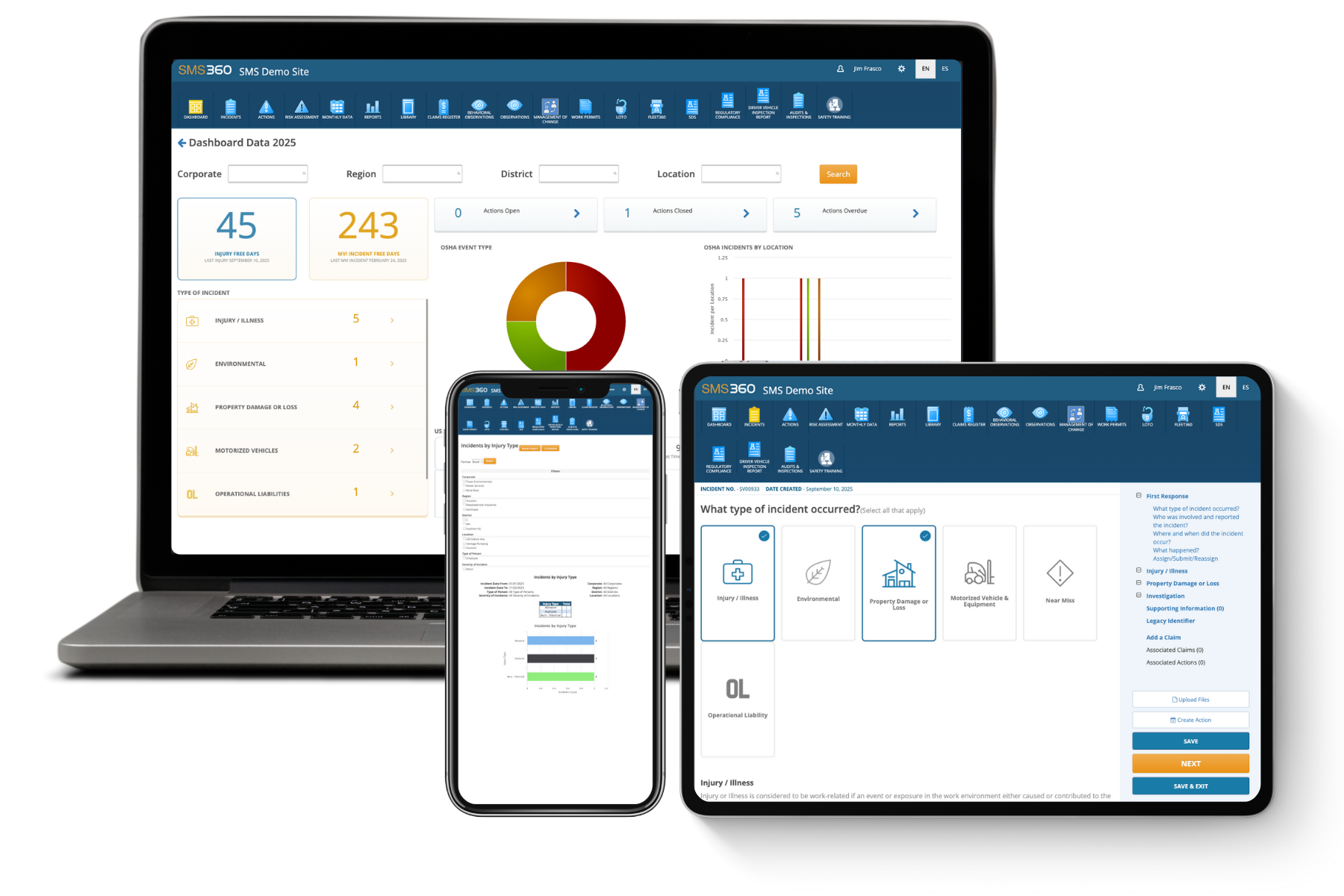
SMS360's incident management, training tracking, inspection, and analytics capabilities generate the data that feeds directly into ESG social pillar reporting. OSHA incident rates, corrective action closure rates, training completion percentages, and inspection scores are all outputs of a well-managed SMS360 program — and all are material ESG metrics. By running their safety program through SMS360, organizations are simultaneously building the ESG data infrastructure they need to meet disclosure requirements and demonstrate to investors, customers, and regulators that their safety commitments are real and measurable.
Frequently Asked Questions
What is the difference between ESG reporting and ESG performance?
ESG performance refers to how well an organization actually manages its environmental, social, and governance risks and opportunities — the substantive outcomes it achieves, such as reduced incident rates, lower emissions, or stronger governance practices. ESG reporting refers to the process of disclosing that performance to external stakeholders through structured reports, regulatory filings, or third-party assessments. The distinction matters because organizations can produce sophisticated ESG reports without actually improving their underlying performance, and conversely, organizations with genuinely strong EHS and sustainability programs sometimes fail to capture the reputational and investor benefits because their reporting is inadequate. The goal is to align reporting and performance — using the discipline of external disclosure to drive genuine operational improvement.
Which industries face the most significant ESG scrutiny related to workplace safety?
Industries with higher inherent safety risk face the most intense ESG scrutiny on social pillar metrics. Construction, manufacturing, oil and gas, mining, transportation and logistics, and agriculture are all sectors where investors and ESG rating agencies apply particular weight to safety performance. High incident rates, fatalities, or regulatory violations in these sectors are increasingly treated as indicators of broader management quality and risk exposure, not just operational safety failures. That said, no industry is exempt from ESG expectations on workplace safety — even office-based and service businesses are expected to demonstrate basic safety management practices and worker wellbeing programs.
Are small and mid-sized businesses required to report on ESG?
Currently, mandatory ESG reporting requirements in most jurisdictions apply primarily to large publicly traded companies. Smaller private companies are generally not subject to formal disclosure mandates. However, this is changing. Regulatory requirements are expanding, and more importantly, supply chain ESG requirements mean that large companies are increasingly asking their suppliers — including smaller businesses — to provide ESG data as a condition of doing business. If your organization sells to large publicly traded customers, participates in public procurement processes, or seeks investment from ESG-conscious investors, you may face ESG data requests regardless of your own size or listing status.
How do ESG ratings agencies evaluate workplace safety?
Major ESG rating agencies — MSCI, Sustainalytics, ISS ESG, and others — evaluate workplace safety as a component of the social pillar, typically under a labor and health and safety category. They assess quantitative metrics such as TRIR, LTIR, and fatality rates, often benchmarked against industry peers. They also evaluate qualitative factors including whether the organization has a formal health and safety management system, whether safety performance is linked to executive compensation, whether there is transparent reporting on incidents and corrective actions, and whether the organization has experienced significant safety controversies. Organizations that can demonstrate systematic, documented safety management programs score consistently better on these assessments than those with comparable incident rates but weaker governance and transparency.
What should organizations look for when selecting ESG software?
Key considerations when evaluating ESG software include whether the platform supports the specific reporting frameworks your organization needs to comply with (GRI, SASB, TCFD, etc.); how well it integrates with existing operational systems including your EHS platform, HR system, and environmental compliance tools; the quality of its data validation and audit trail capabilities (ESG reports are increasingly subject to external assurance, so data integrity is critical); its workflow and collaboration features for managing the multi-department data collection process; and the vendor's experience with organizations in your industry and of your size. An ESG platform that does not connect to your EHS data requires you to manually bridge the gap between your operational safety performance and your external disclosures — a significant inefficiency and a source of risk.
.png)