
Safety software is an investment — and like any investment, leadership wants to know what it returns. Here is how to quantify the value of a modern EHS platform and make a compelling case to the people who hold the budget.
Safety professionals often find themselves in a difficult position when it comes to budget conversations. The value of preventing an incident is real and significant, but it is inherently invisible — you cannot point to the injury that did not happen. Meanwhile, the cost of safety software is concrete, immediate, and visible. Bridging this gap requires a structured approach to measuring and communicating the return on investment from safety technology — one that goes beyond incident prevention to capture the full range of operational, financial, and strategic benefits that a well-implemented EHS platform delivers.
The Real Cost of Workplace Incidents
Before building the case for safety software, it is worth understanding what you are measuring against. The direct costs of workplace incidents — medical treatment, workers' compensation claims, and regulatory fines — are only the visible portion of the total financial impact.
Direct Costs
Direct incident costs include emergency medical treatment and hospitalization, workers' compensation claims (both medical and indemnity payments), OSHA fines and penalties, legal defense and settlement costs, and equipment repair or replacement. These costs are real, documented, and quantifiable, but they typically represent only 20 to 40 percent of the total financial impact of a serious incident.
Indirect Costs
Indirect costs are often four to ten times the direct costs and include production downtime and lost output, time spent by supervisors, safety staff, and HR on investigation and paperwork, overtime costs to cover for the injured worker, hiring and training costs for a replacement, reduced productivity from remaining workers due to morale impact, reputational damage affecting customer relationships and talent recruitment, and management time diverted from productive activities. The National Safety Council estimates the average cost of a medically consulted injury at over $40,000 — and that figure does not include the indirect costs that multiply the true financial impact.
Quantifying the ROI of Safety Software
Reduced Incident Rates
The most direct financial benefit of safety software is the reduction in incident rates that comes from more systematic hazard identification, faster corrective action, better training management, and improved near-miss reporting. Organizations that implement comprehensive EHS platforms consistently report measurable reductions in recordable incident rates within 12 to 24 months. Even a modest reduction — cutting your TRIR from 3.5 to 2.8 — translates to a meaningful reduction in workers' compensation costs, lost time, and indirect incident expenses.
Labor and Time Savings
Safety management in most organizations without dedicated software is extraordinarily time-intensive. Safety managers and coordinators spend hours each week manually compiling incident reports, following up on corrective actions, preparing for audits, and generating compliance reports from spreadsheets. A centralized EHS platform automates much of this work: OSHA reports generate automatically, corrective action reminders go out without manual follow-up, and inspection data aggregates into dashboards without anyone having to copy and paste from paper forms. Conservative estimates of time savings from EHS platform implementations typically run two to five hours per week per safety staff member — hours that can be redirected to higher-value prevention activities.
Audit and Compliance Cost Reduction
Organizations that are not audit-ready pay a significant premium when inspections occur. Scrambling to locate records, reconstruct incident histories, and document corrective action completion wastes time and creates risk. An EHS platform that maintains a complete, organized, and instantly accessible record of all safety activities dramatically reduces audit preparation time and improves outcomes. It also reduces the risk of costly OSHA citations for recordkeeping violations, which can run into thousands of dollars per violation.
Workers' Compensation Premium Impact
Many insurers offer premium discounts or better renewal terms to organizations that can demonstrate systematic safety management programs. A documented reduction in incident rates, supported by evidence of a robust EHS management system, is a tangible negotiating asset at insurance renewal. For larger organizations, even a modest reduction in workers' compensation premiums can exceed the annual cost of a safety management platform many times over.
How SMS360 Delivers ROI
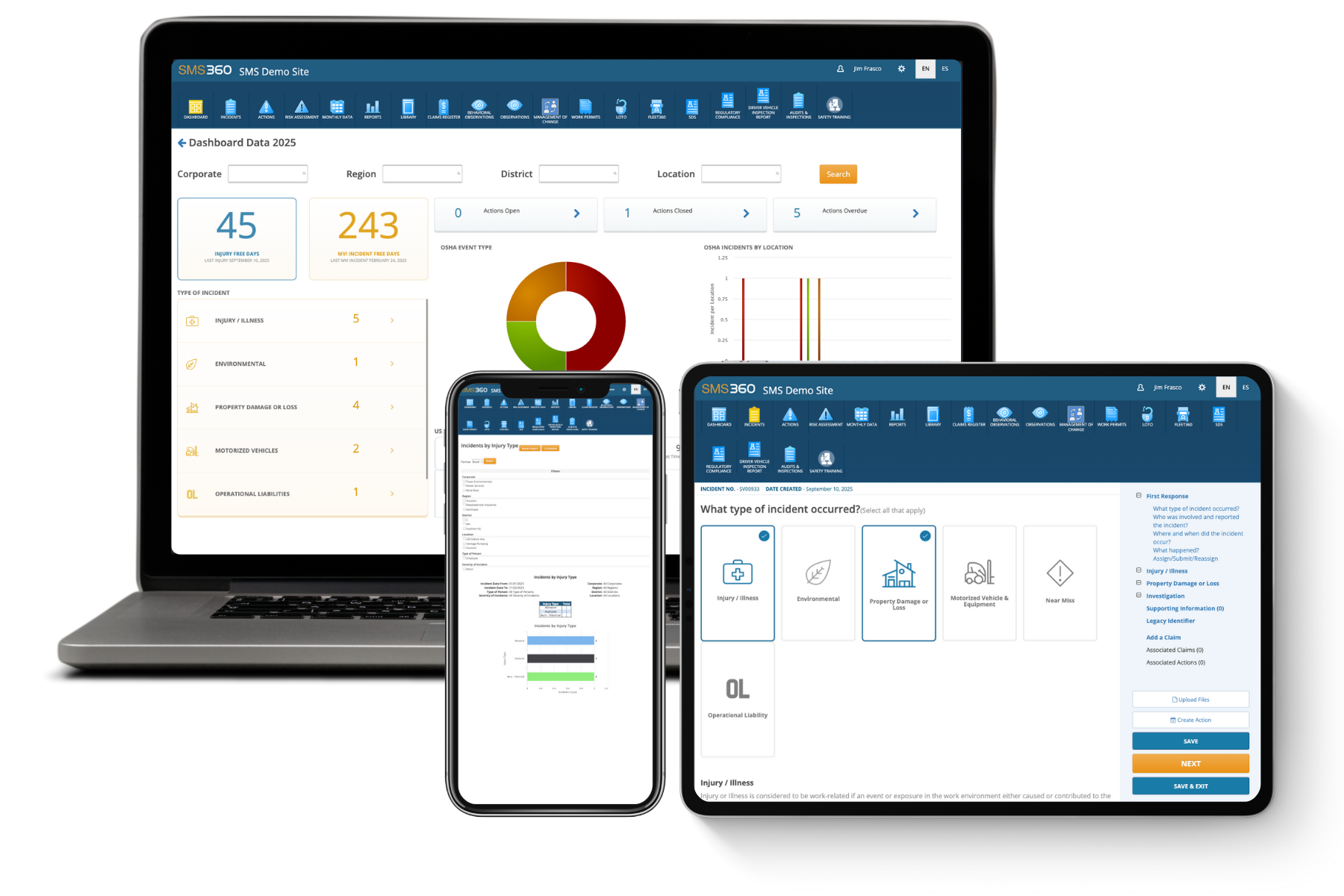
SMS360 is built specifically to deliver measurable return on investment through time savings, incident reduction, and compliance efficiency. The platform replaces scattered spreadsheets and manual tracking with a single connected system that automates reporting, streamlines corrective action management, and gives leadership real-time visibility into safety performance. With unlimited users and transparent, employee-count-based pricing — and no long-term contracts — SMS360 makes it straightforward to calculate the cost of the platform against the value it delivers.
Building the Business Case
Establish Your Baseline
Before making the case for safety software, document your current state: incident rates and associated costs for the past two to three years, time spent by safety staff on administrative tasks, audit preparation costs, current workers' compensation premiums, and any recent OSHA citations or penalties. This baseline is the foundation of your ROI calculation.
Model the Expected Return
Using industry benchmarks for incident rate reductions from EHS platform implementations, estimate the financial value of a realistic improvement in your incident rate. Add the estimated labor savings from automation and the potential workers' compensation premium impact. Compare this to the annual cost of the platform. Most organizations find that the payback period for a well-implemented EHS platform is less than 12 months.
Frequently Asked Questions
How long does it typically take to see ROI from safety software?
Most organizations begin to see measurable returns within 6 to 12 months of full implementation. The fastest returns typically come from labor and time savings — the hours safety staff no longer spend on manual reporting and corrective action tracking are immediately recoverable. Incident rate improvements, which drive the largest financial returns, typically take 12 to 24 months to show up clearly in the data, as it takes time for the behavioral and process changes enabled by the platform to translate into measurable reductions in incident frequency. Organizations that implement the full suite of features — incident management, inspections, training tracking, and corrective actions — and drive consistent adoption across their workforce see returns most quickly.
What metrics should be used to measure safety software ROI?
The most important metrics for measuring safety software ROI fall into three categories. Financial metrics include workers' compensation costs before and after implementation, OSHA fine and penalty costs, legal and settlement costs related to workplace incidents, and insurance premium changes. Operational metrics include incident rates (TRIR, DART, LTIFR), near-miss reporting volume, corrective action closure time and rates, and training completion rates. Efficiency metrics include time spent by safety staff on administrative tasks, audit preparation time, and report generation time. Tracking all three categories gives a complete picture of the platform's value and provides the data needed to demonstrate ROI to leadership and justify continued or expanded investment.
How do you account for incidents that didn't happen when calculating ROI?
This is the central challenge of safety investment justification. The standard approach is to use your historical incident rate and the known average cost of incidents to estimate expected incident costs in the absence of the intervention, and then compare that to actual costs after implementation. For example, if your historical rate suggests you would expect five recordable incidents per year at an average fully loaded cost of $40,000 each, and your post-implementation rate shows three incidents, you can attribute approximately $80,000 in avoided costs to the program. For prospective ROI calculations — before implementation — industry benchmark data on incident rate reductions achieved by similar organizations using EHS platforms provides a reasonable basis for estimation. OSHA and the National Safety Council both publish data on average incident costs by industry and severity that can support these calculations.
Does safety software reduce OSHA fines?
Directly, safety software does not prevent OSHA from citing violations it discovers during an inspection. However, it reduces exposure in several important ways. First, organizations with documented, systematic safety programs are less likely to have the underlying conditions that generate OSHA violations in the first place. Second, when violations are identified through internal inspections and corrected with documented corrective actions, organizations avoid the OSHA citation that would have resulted from those conditions remaining unaddressed. Third, when OSHA does conduct an inspection, organizations with complete electronic records of their safety activities are better positioned to demonstrate good faith compliance efforts, which can reduce penalty amounts. OSHA's penalty structure explicitly considers the size of the business, the severity of the violation, the employer's good faith, and the employer's history of prior violations — all areas where a well-documented safety program provides a meaningful advantage.
Is safety software affordable for small and mid-sized businesses?
The cost of safety software has decreased significantly as cloud-based, SaaS platforms have replaced the expensive on-premise systems that once dominated the market. SMS360, for example, uses transparent employee-count-based pricing with unlimited users and no long-term contracts, making it accessible to organizations of virtually any size. For small and mid-sized businesses, the ROI calculation is often even more favorable than for large enterprises because they tend to have fewer dedicated safety staff, making the labor savings from automation proportionally more valuable. A small manufacturer that can eliminate 10 hours per week of manual safety administration at a fully loaded labor cost of $50 per hour is saving $26,000 per year in staff time alone — often exceeding the annual platform cost several times over.
.png)