
OSHA recordkeeping requirements trip up even experienced safety managers. Here is everything you need to know about the 300 log, the 300A summary, and the 301 incident report — and how to stay compliant year-round.
OSHA's injury and illness recordkeeping requirements are among the most foundational obligations in workplace safety compliance. The 300 log, the 300A annual summary, and the 301 incident report form together create the official record of a covered employer's workplace injury and illness experience. These records drive OSHA enforcement priorities, inform national occupational health statistics, support workers' compensation proceedings, and — critically — give safety managers the incident data they need to identify trends and drive prevention.
Yet despite their importance, recordkeeping errors are extraordinarily common. Organizations misclassify cases, miss recording deadlines, fail to post the 300A summary at the right time, or simply do not understand which cases are recordable. OSHA cites recordkeeping violations regularly, and the penalties — while not as dramatic as those for hazard-related violations — can be significant, particularly for willful or repeated failures. This guide covers everything safety managers need to know to maintain accurate, compliant records.
Who Is Required to Keep OSHA Records?
OSHA's recordkeeping rule (29 CFR Part 1904) applies to most private-sector employers with 11 or more employees. Employers with 10 or fewer employees are partially exempt, as are employers in certain low-hazard industries identified in OSHA's regulations. However, all covered employers — regardless of size or industry — must report to OSHA within specified timeframes when a work-related fatality, inpatient hospitalization, amputation, or loss of an eye occurs.
State Plan States
Twenty-two states and two territories operate their own OSHA-approved state plans with recordkeeping requirements that are at least as effective as federal OSHA's. Employers in state plan states must comply with their state's requirements, which may differ from federal requirements in specific ways — a fact that multistate employers need to monitor carefully.
Understanding the Three OSHA Forms
The OSHA 300 Log: Log of Work-Related Injuries and Illnesses
The OSHA 300 log is a running record of every work-related injury or illness that meets the criteria for recordability. It is maintained on a calendar year basis and must be updated within seven calendar days of receiving information that a recordable case has occurred. The log captures basic information about each case: the worker's name, job title, date of injury or illness onset, work location, a brief description of the injury or illness, the affected body part, and the case classification — whether it involved days away from work, restricted or transferred work, other recordable cases requiring medical treatment beyond first aid, or a work-related fatality, hearing loss diagnosis, or cancer case.
The 300 log is a working document that should be updated throughout the year. It is not submitted to OSHA unless specifically requested during an inspection, but it must be available for inspection by OSHA compliance officers, workers, former workers, and their representatives upon request.
The OSHA 301 Incident Report
The OSHA 301 form is a more detailed record of each individual case entered on the 300 log. It captures information about the worker (name, address, date of birth, date of hire, gender), the physician or healthcare professional who treated the worker, the case details including the time of the event, the specific activity the worker was engaged in, what the worker was doing just before the incident, how the injury or illness occurred, the object or substance that directly harmed the worker, and the nature of the injury or illness.
Employers may use the OSHA 301 form directly or substitute an equivalent form — such as a workers' compensation first report of injury — provided it contains all of the required information. The 301 must be completed within seven calendar days of receiving information about a recordable case.
The OSHA 300A Annual Summary
The OSHA 300A is a summary of the year's injury and illness data from the 300 log. It must be completed at the end of each calendar year, certified by a company executive (not just a safety manager — an owner, officer, or the highest-ranking company official at the establishment), and posted in a conspicuous location at each establishment from February 1 through April 30 of the following year.
The 300A captures total counts of deaths, days away from work cases, restricted or job transfer cases, other recordable cases, and total days away and days of restriction or job transfer, along with the establishment's industry classification, average number of employees, and total hours worked. This data forms the basis for OSHA's publicly available injury and illness statistics and is used to calculate incident rates.
What Makes a Case Recordable?
This is the question that generates the most confusion — and the most recordkeeping errors. A work-related injury or illness is recordable if it results in death, days away from work, restricted work or job transfer, medical treatment beyond first aid, loss of consciousness, diagnosis of a significant injury or illness by a healthcare professional, or specific conditions including work-related cancer, chronic irreversible disease, fractured or cracked bone, and punctured eardrum.
Work-Relatedness
A case is work-related if an event or exposure in the work environment either caused or contributed to the resulting condition or significantly aggravated a pre-existing condition. The work environment includes the physical establishment, any other location where employees are working, and the equipment or materials used in the course of work. There are specific exceptions to work-relatedness — injuries that occur on the employer's premises during personal tasks unrelated to work, injuries in parking lots during normal commutes, and certain voluntary wellness activity injuries, among others.
First Aid vs. Medical Treatment
One of the most important distinctions in OSHA recordkeeping is the line between first aid (not recordable on its own) and medical treatment beyond first aid (recordable). OSHA's definition of first aid is specific and includes a defined list of treatments: non-prescription medication at non-prescription strength, tetanus immunizations, cleaning and bandaging minor wounds, use of non-rigid means of support such as bandages and wraps, and a few other limited interventions. Any treatment beyond this list — prescription medication, sutures, use of rigid splints or casts, physical therapy ordered by a physician — constitutes medical treatment beyond first aid and makes the case recordable if it is work-related.
Electronic Submission Requirements
OSHA's electronic recordkeeping rule requires certain employers to electronically submit their injury and illness data through OSHA's Injury Tracking Application (ITA). The submission requirements depend on establishment size and industry. Establishments with 250 or more employees in industries covered by OSHA's recordkeeping rule must submit their 300A data electronically. Establishments with 20 to 249 employees in certain high-hazard industries must also submit 300A data electronically. OSHA has also extended electronic submission requirements to include 300 log and 301 data for larger establishments in high-hazard industries. Submission deadlines and requirements have evolved in recent years, and employers should verify current requirements annually.
How SMS360 Simplifies OSHA Recordkeeping
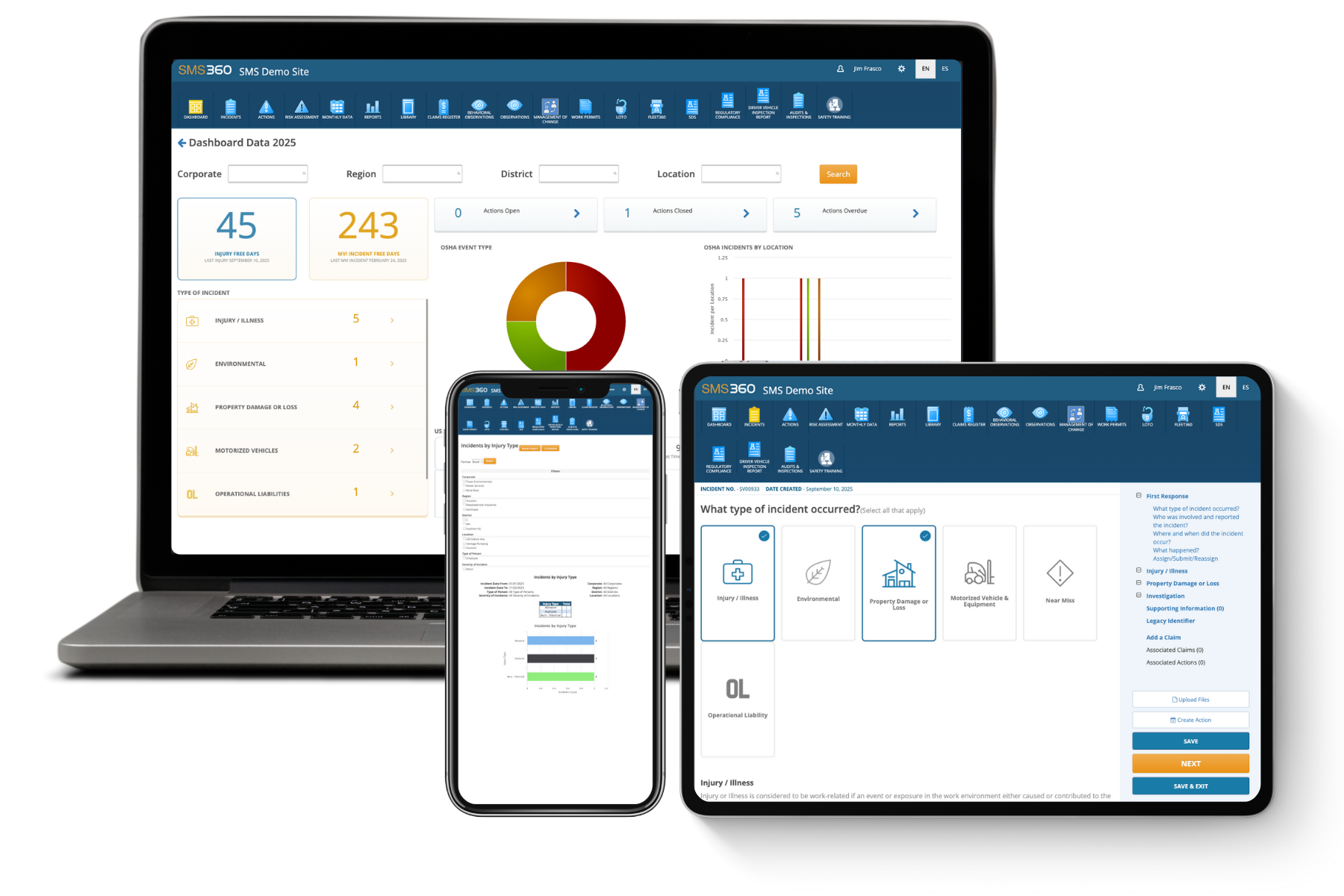
SMS360 automates OSHA and DOT reporting from incident data captured in the platform. When incidents are logged in SMS360 — with photos, witness statements, root cause documentation, and treatment information captured at the time — the system generates the required reports automatically, eliminating the manual data entry and transcription errors that plague paper-based recordkeeping systems. The platform maintains a complete, organized incident history that is instantly accessible for OSHA inspections, audit requests, and annual summary preparation. By replacing disconnected spreadsheets and paper logs with a single connected system, SMS360 gives safety managers confidence that their records are accurate, complete, and ready when they need them.
Frequently Asked Questions About OSHA 300 Forms
What is the deadline for recording a case on the OSHA 300 log?
OSHA requires that recordable cases be entered on the 300 log within seven calendar days of receiving information that a recordable case has occurred. Note that this is seven days from when you receive information — not seven days from the incident date. If a worker sees a physician three weeks after an incident and receives a prescription, the clock starts from when you learn about that treatment, not from the original incident date. The seven-day rule also means that cases sometimes need to be updated after initial recording — for example, if a case initially recorded as other recordable later results in days away from work, the entry must be updated to reflect the correct classification. Maintaining accurate, timely records requires a clear process for receiving and acting on new medical information as it becomes available.
Who can sign the OSHA 300A annual summary certification?
OSHA requires the 300A to be certified by a company executive — specifically, an owner of the company, an officer of the corporation, the highest-ranking company official working at the establishment, or the immediate supervisor of the highest-ranking official at the establishment. A safety manager, HR director, or other non-executive employee cannot certify the 300A on their own authority. This requirement reflects OSHA's intent that senior leadership take personal accountability for the accuracy of injury and illness records. The certifying official is attesting that they have examined the records and reasonably believe them to be accurate and complete — a representation with legal significance.
Does OSHA require the posting of the full 300 log, or just the 300A summary?
Only the 300A annual summary must be posted — not the full 300 log. The 300A must be posted from February 1 through April 30 each year, in a conspicuous location where workers can see it. The full 300 log must be made available for review by current and former employees, their representatives, and OSHA compliance officers upon request, but it is not required to be posted. Workers have the right to access the log in a reasonable time and manner, and the log should be made available without requiring them to take unusual steps. Importantly, the names of workers with privacy concern cases — which include cases involving sexual assaults, mental illness, HIV/AIDS, and certain other sensitive conditions — must be entered as "privacy case" on the 300 log rather than with the worker's name.
What happens if an OSHA inspection reveals recordkeeping errors?
OSHA compliance officers are trained to review recordkeeping records as part of virtually every inspection. Common errors they look for include cases that should have been recorded but were not (under-recording), cases recorded in the wrong classification, cases recorded that are not actually recordable (over-recording), and administrative errors such as missing information or late entries. Recordkeeping violations can be cited as serious violations with penalties of up to $16,131 per violation, or as willful or repeated violations with penalties up to $161,323 per violation when OSHA finds intentional under-recording. Beyond penalties, OSHA may request records going back up to five years, so errors can have consequences well beyond the current inspection year. Organizations that discover their own recordkeeping errors before an OSHA inspection should correct them promptly and document the correction — proactive correction is always preferable to having errors discovered during enforcement.
How should multi-site employers manage OSHA recordkeeping across locations?
OSHA's recordkeeping requirements apply at the establishment level — each physical location where business is conducted is a separate establishment for recordkeeping purposes. Multi-site employers must maintain separate 300 logs for each establishment with 11 or more employees, post separate 300A summaries at each location, and track incident rates separately for each establishment. Centralized management of multi-site recordkeeping is one of the strongest arguments for a cloud-based safety management platform, because it allows safety staff at any location to enter incident data that feeds into the correct establishment's records while giving central safety leadership visibility across all locations simultaneously. Attempting to manage multi-site OSHA recordkeeping through location-specific spreadsheets is a common source of errors, inconsistencies, and compliance gaps.
.png)